30-Second Answer
What's the difference between Kung Pao and Szechuan Chicken?
Kung Pao Chicken points to one real dish, Gong Bao Ji Ding: diced chicken, peanuts, dried chiles, aromatics, and a glossy sauce that balances savory, sour, sweet and heat. Szechuan Chicken points to a much looser idea: chicken in a spicy, often garlicky, chile-heavy sauce with vegetables thrown in. Want the dish with peanuts and real balance? Order Kung Pao. Want a straightforwardly spicy chicken plate? Ask the restaurant what they mean by Szechuan, because it changes a lot.
The real question here isn't 'which one is more authentic.' It's simpler than that: one of these is a named dish, the other is a cuisine-flavored menu category. Kung Pao almost always means the same handful of things. Szechuan Chicken can mean five different plates depending on which restaurant you're sitting in.
The Naming Trap
Sichuan is a region. Szechuan Chicken is often just a vibe.
Sichuan is the modern spelling for the province and its cuisine. Szechuan is an older English spelling that never fully went away, mostly because restaurant menus don't update on anyone's schedule. Both spellings are usually pointing at the same general region, but neither one tells you the kitchen is actually doing Sichuan technique well.
Kung Pao is different because it's naming an actual dish with recognizable parts, chicken, peanuts, chiles, sauce. For more on where that name comes from, see the Gong Bao Ji Ding meaning guide. Szechuan Chicken, on the other hand, is usually naming a direction: spicy, garlicky, chile-forward, maybe a little numbing, maybe loaded with vegetables. If a menu treats 'Szechuan Chicken' like it's one fixed historical recipe, take that with a grain of salt.
Comparison Table
Kung Pao vs. Szechuan Chicken at a glance
| Point | Kung Pao Chicken | Szechuan Chicken |
|---|---|---|
| What the name means | One specific dish, Gong Bao Ji Ding. You can expect diced chicken, peanuts, dried chiles, aromatics, and a balanced sauce. | Usually a menu label for spicy, Sichuan-style chicken. More of a flavor promise than one fixed recipe. |
| Spelling | Kung Pao is the common English menu spelling. Gong Bao is closer to modern pinyin. | Sichuan is the modern standard spelling. Szechuan is the older spelling that stuck around on menus. |
| Sauce | Glossy, clingy, savory, tangy, a little sweet, chile-fragrant, built to coat chicken and peanuts without pooling. | Often hotter and garlickier, chile-forward, less consistent. Can be saucy, dry-fried, or loaded with vegetables depending on the place. |
| Heat | Can be spicy, but the real goal is balance: heat, vinegar snap, soy depth, peanut crunch, sometimes a light Sichuan peppercorn tingle. | Usually expected to run hotter or more numbing in U.S. ordering logic, though it really varies by kitchen. |
| Peanuts | Usually yes. Peanuts are a core part of the dish, not a garnish. | No fixed rule. If peanuts show up, the kitchen is probably borrowing from Kung Pao. |
| Vegetables | Classic versions keep it simple: chicken, scallion, chiles, peanuts. American versions often add zucchini or bell pepper. | Very flexible: onion, bell pepper, celery, carrot, broccoli, mushroom, whatever the kitchen's spicy chicken usually includes. |
| Ordering risk | Fairly predictable since the dish has a clear identity. Main risk is a version that's gone too sweet and saucy. | Less predictable since the name covers a wide range. Best move is just asking what their version actually is. |
Kung Pao Signals
What a real Kung Pao plate should look like
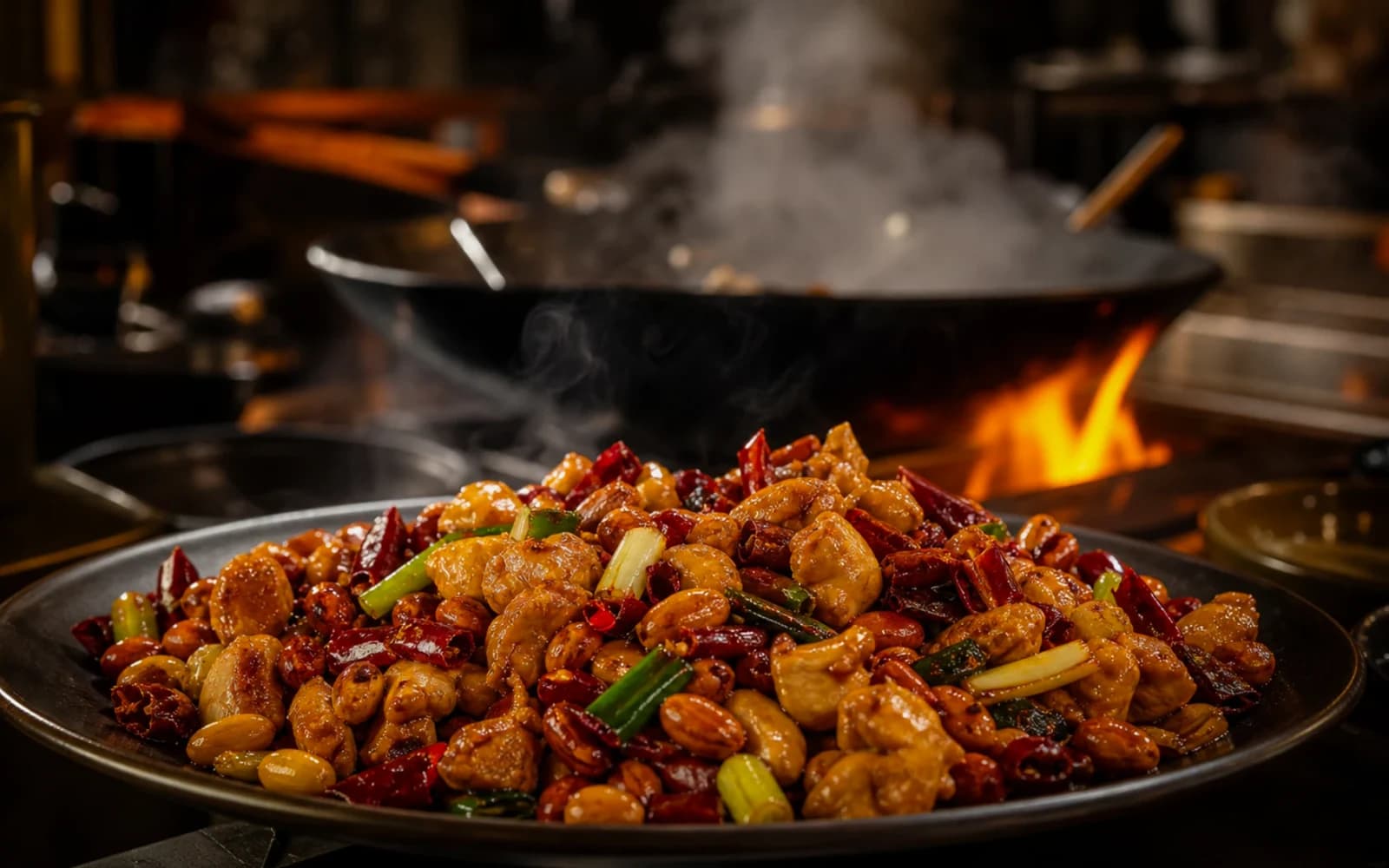
A solid Kung Pao Chicken has a clear structure: diced chicken, peanuts, dried chiles, garlic, ginger, scallion, maybe a little Sichuan peppercorn if the kitchen is taking the Sichuan side seriously, and a sauce that clings to everything instead of pooling at the bottom. The authentic Kung Pao Chicken guide turns this into a visual checklist. The Kung Pao Chicken photo guide is useful here too, it shows what those signals actually look like before a 'Szechuan' label muddies things.
Kung Pao isn't just 'the spicy one with peanuts.' The dice, the sauce, the timing, and that sweet-sour-savory balance all matter just as much. For the sauce breakdown, see Kung Pao sauce. If the sauce turns into a red puddle at the bottom of the plate, something already went sideways.
Szechuan Signals
What Szechuan Chicken usually means on a U.S. menu
Szechuan Chicken is harder to pin down because it keeps meaning different things depending on where you order it. In a lot of American restaurants it just means sliced or diced chicken with vegetables in a spicy garlic-chile sauce. In some kitchens it leans toward actual Sichuan peppercorn and that numbing heat. In others it's basically shorthand for 'this one's redder and hotter than our mild chicken dish.'
Might mean spicy garlic chicken
A lot of American menus use this name for sliced chicken and vegetables in a red-brown garlic-chile sauce.
Might lean toward mala heat
Some versions go for real Sichuan peppercorn tingle and dried chile fragrance, but how much varies a lot by kitchen.
Might be vegetable-heavy
Bell pepper, onion, carrot, celery, broccoli, mushroom, whatever the kitchen normally throws into a stir-fry.
Might just mean hotter than Kung Pao
That's the common expectation, but it's an ordering habit, not a historical fact about the dish.
Might not reflect Sichuan cooking at all
A menu can say Szechuan without actually using Sichuan technique. The word alone doesn't guarantee anything.
Can still be really good
None of this is a knock on the dish itself. It's just not the same kind of thing as a named recipe like Kung Pao.
Sauce And Heat
Kung Pao balances. Szechuan Chicken goes big.
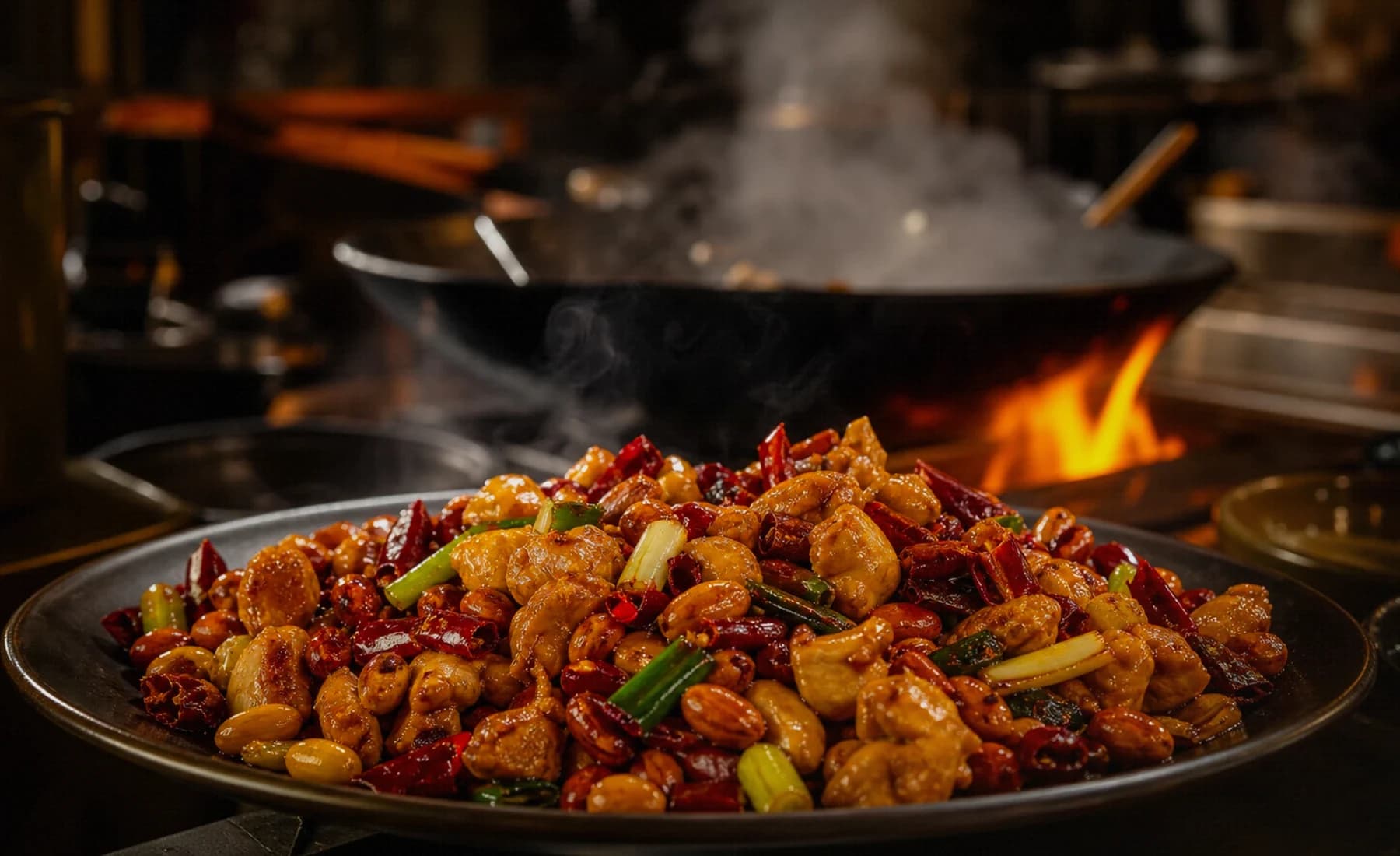
Kung Pao sauce is meant to feel dialed in: soy for depth, vinegar for brightness, a little sugar, starch for grip, chile fragrance, enough heat to make the peanuts pop. It's allowed to be spicy, but spice alone isn't the whole point. For the full breakdown of the dish, see What Is Kung Pao Chicken?
Szechuan Chicken tends to sell itself on impact. The sauce might be garlicky, chile-heavy, oily, thick, or loaded with vegetables, depending entirely on the kitchen. A good one is loud and exciting. A lazy one just tastes like generic spicy brown sauce wearing a regional label. The easiest fix is asking one direct question: is your Szechuan Chicken more spicy-garlic, more mala, or more sweet takeout sauce?
Sweet, sour, savory sauce, dried chile fragrance, peanuts, quick wok timing.
Usually more garlic, more chile, more vegetables, and a bigger heat swing, with way less fixed structure.
The Szechuan label covers so much ground that one quick question saves you from a surprise.
Ordering Guide
Which one should you order?
Order Kung Pao if you want peanuts and balance
You're ordering a named dish: diced chicken, peanuts, dried chiles, aromatics, and a sauce that should cling, not flood.
Order Szechuan Chicken if you want a broader spicy plate
You're usually asking for heat, garlic, chile, vegetables, and whatever that specific restaurant's version of Sichuan-style chicken is.
Ask about peanuts if allergies matter
Kung Pao almost always has peanuts. Szechuan Chicken is much less predictable, so ask directly.
Ask about spice if heat matters to you
Kung Pao isn't automatically mild, and Szechuan Chicken isn't automatically blazing. It varies more than the menu lets on.
Simple version: want peanuts and a dish with real structure, order Kung Pao. Want the kitchen's spicy setting turned up, order Szechuan Chicken. If a menu claims the two are identical except for spice level, that menu needs a second look.
Common Misunderstandings
Things menus make blurrier than they need to be
Szechuan isn't one dish
Sichuan is a region and a cuisine. Szechuan Chicken on a U.S. menu is usually a category, not one classic recipe.
Kung Pao is Sichuan-linked, not the whole cuisine
Kung Pao fits inside the Sichuan conversation, but it doesn't represent every Sichuan flavor. One dish can't carry a whole province.
Szechuan doesn't just mean spicy
Sichuan cooking covers a lot of ground. Mala gets the spotlight, but there's also sour, sweet, aromatic, pickled, and fermented flavors in the mix.
Sichuan peppercorn isn't just heat
It brings a tingling, numbing, slightly citrusy sensation. That's why Sichuan-style heat feels different from plain chile burn.
American Kung Pao can drift
Zucchini, bell pepper, extra sweetness, thicker sauce, all common in American versions. Peanuts are usually the last thing that stays true to the original.
Spelling doesn't decide quality
Sichuan is the modern spelling, Szechuan is common menu English. A great dish can use either word. A weak dish can spell it perfectly and still miss the mark.
FAQ / Search Court
Questions people ask before choosing a spicy chicken
Is Kung Pao Chicken Szechuan?
Kung Pao Chicken is strongly linked to Sichuan cuisine, but it's a specific dish. Szechuan Chicken on most American menus is a broader spicy chicken label, not one fixed classic recipe.
What's the main difference between Kung Pao and Szechuan Chicken?
Kung Pao is more specific: diced chicken, peanuts, dried chiles, aromatics, and a balanced glossy sauce. Szechuan Chicken is usually less standardized and often just means a hotter, garlickier chicken dish with vegetables.
Is Kung Pao spicier than Szechuan Chicken?
Not always. In American ordering habits, Szechuan Chicken is often expected to be hotter. Classic Kung Pao can be spicy too, but its identity leans more on balance, peanuts, and sauce control than raw heat.
Does Kung Pao Chicken have peanuts?
Usually, yes. Peanuts are one of Kung Pao's strongest signals. Szechuan Chicken doesn't come with the same expectation.
What is Szechuan Chicken exactly?
On most U.S. menus it means chicken in a spicy, Sichuan-inspired sauce, often with garlic, chiles and vegetables. It's usually a broad menu category rather than one historical recipe.
Is it Sichuan or Szechuan?
Sichuan is the modern standard spelling. Szechuan is an older romanization that's stuck around on restaurant menus and in older English food writing.
Should I order Kung Pao or Szechuan Chicken?
Order Kung Pao if you want peanuts, diced chicken, and that sweet-sour-savory balance. Order Szechuan Chicken if you want a more straightforwardly spicy plate and don't mind it varying restaurant to restaurant.
Is Szechuan Chicken the same as Hunan Chicken?
No. Both names often signal "spicy chicken" on American menus, but they point to different regional ideas and different restaurant conventions.