30-Second Visual Answer
What should Kung Pao Chicken look like?
A reliable Kung Pao Chicken photo shows compact chicken pieces, visible peanuts, dried red chiles, and a reddish-brown gloss. The plate should look quick-cooked and separated, not submerged. For the broader dish definition, start with what Kung Pao Chicken is; for stricter judging, use the authentic Kung Pao Chicken checklist.
Photos are useful because Kung Pao Chicken has visible grammar. The dice say something. The peanuts say something. Dried chiles say something. A sauce lake says something too, though usually in the tone of a defendant asking for a plea deal. Visual evidence is not flavor proof, but it gives searchers, cooks, and the WKPO tribunal a shared starting point.
Quick Visual Checklist
Eight things to inspect in a Kung Pao Chicken photo.
- Chicken appears as small cubes or compact bite-size pieces, not long strips or giant battered chunks.
- Peanuts are visible and look crisp, usually whole or halved, not dissolved into the sauce.
- Dried red chiles are present and look cooked in oil, not sprinkled on as decoration after the fact.
- Scallion sections or small aromatics appear as green punctuation, not as a wet vegetable pile.
- The sauce coats the chicken and peanuts lightly; the bottom of the plate is not a soup basin.
- The color reads glossy reddish-brown, not neon orange, gray, or blackened sludge.
- Sichuan peppercorn may appear as small dark specks; the photo cannot prove the tingle, but it can show evidence.
- If bell peppers, zucchini, carrots, or celery dominate the frame, the plate is probably an adaptation.
Photo Examples
Eight reference images, eight different jobs.
A good photo page needs more than one handsome plate. It needs distance, angle, purpose, and honest captions. The examples below cover the main visual jobs: primary reference, kitchen setting, bite close-up, overhead distribution, fine-dining variation, ingredient support, and concept warning.
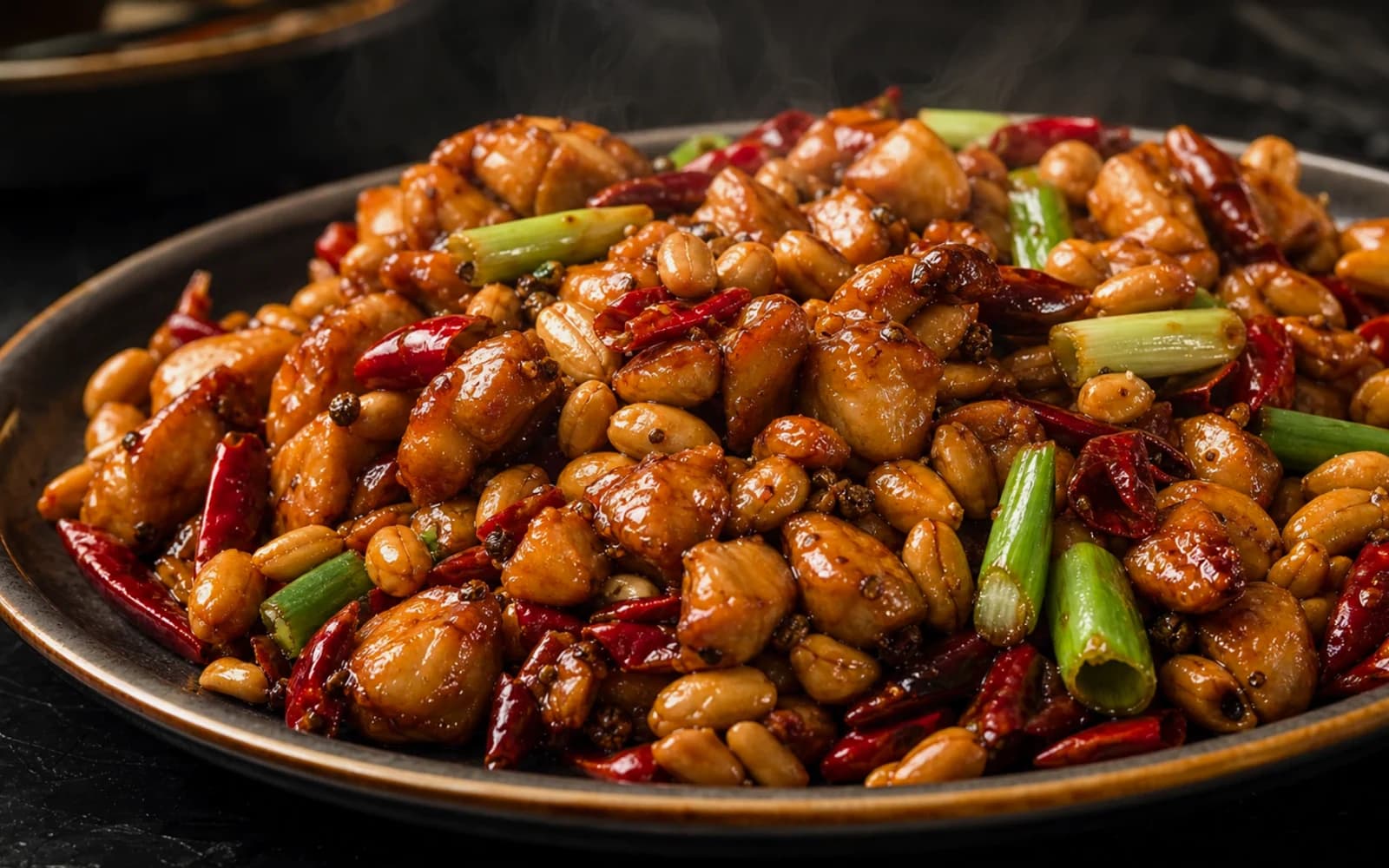
A strong reference photo: chicken dice, peanuts, dried chiles, scallion sections, and a thin glossy coat are all visible.
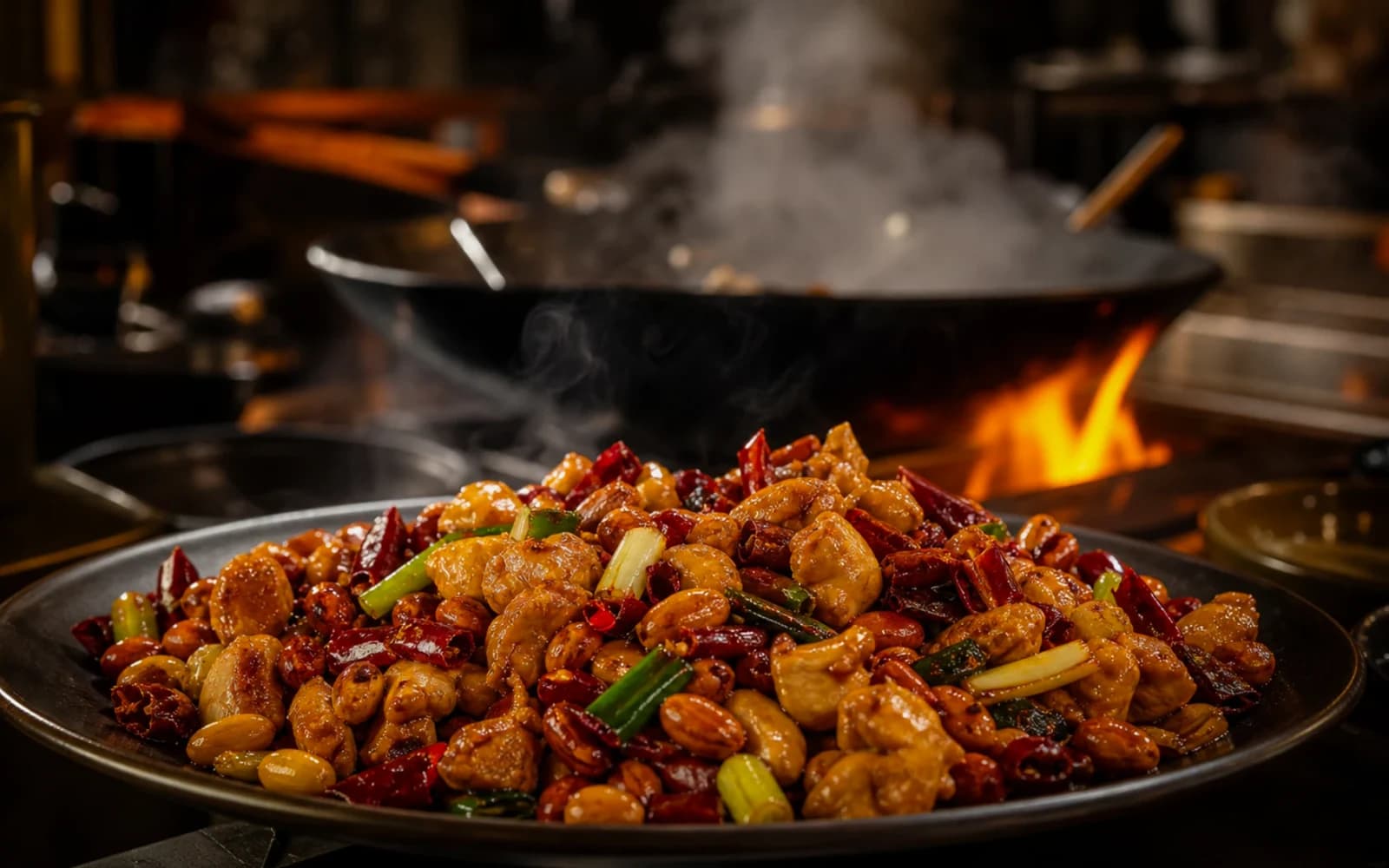
The background suggests wok heat, but the important evidence is still on the plate: separate pieces, chiles, peanuts, and scallions.
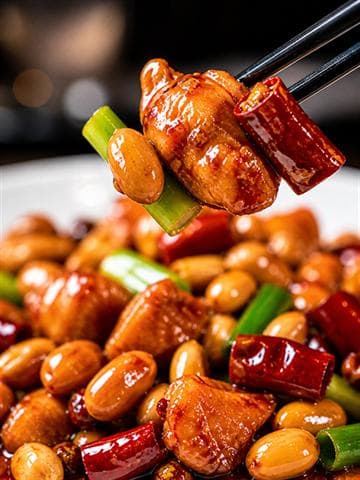
A useful close-up because it shows scale. The chicken piece, peanut, scallion, and dried chile sit in one bite-size frame.
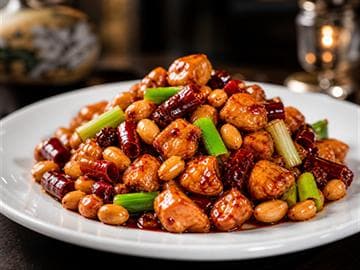
A clearer restaurant-style plate: the sauce is glossy, not flooded, and the peanuts remain easy to count without forensic equipment.
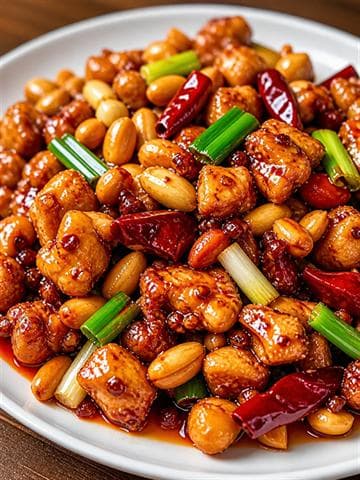
Overhead photos are helpful when judging distribution: peanuts, chiles, scallions, and sauce are all visible across the plate.
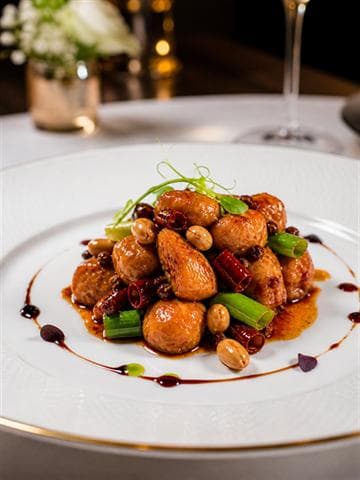
This is not the everyday takeout silhouette. It still keeps the main signals: chicken, peanuts, dried chiles, scallions, and controlled sauce.
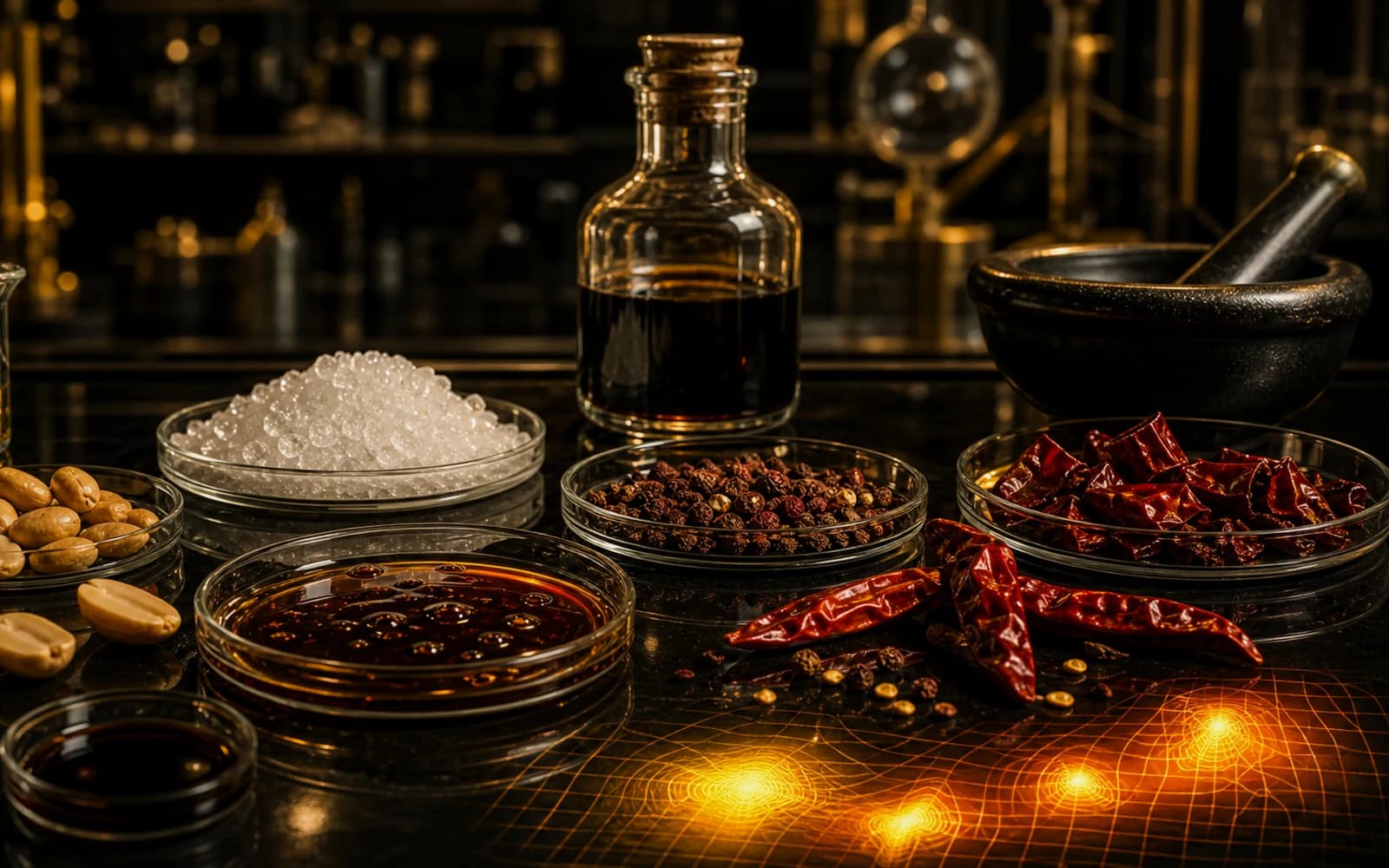
A support image for the visual checklist. It shows the ingredients a viewer should expect to recognize in the cooked dish.
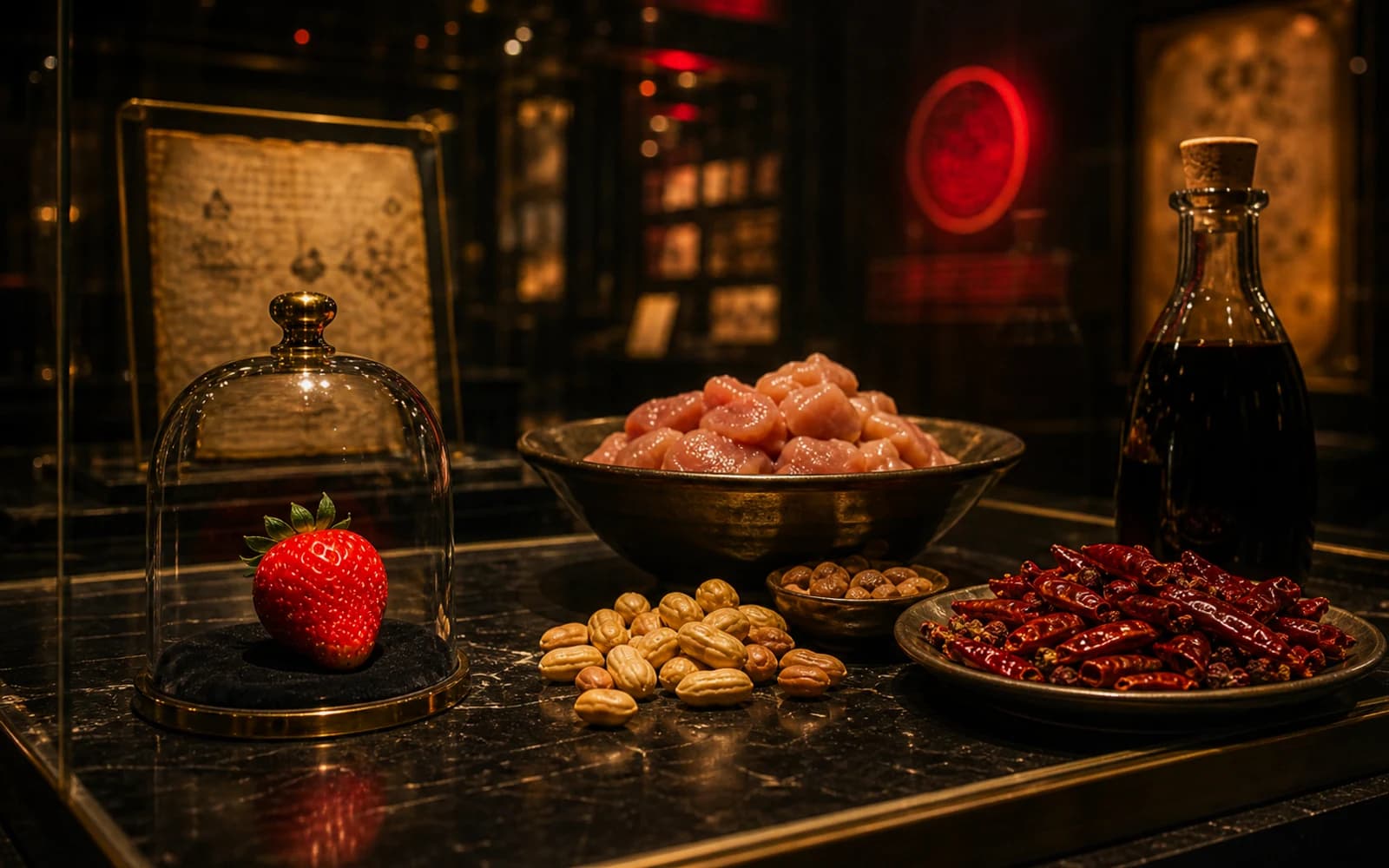
This is a concept image, not a reference plate. It is useful for one warning: lychee flavor is a sweet-sour balance, not a license to add random fruit.
Authentic Vs Adapted
Not every different-looking photo is wrong.
A Sichuan-leaning plate usually keeps the cast tight: chicken, peanuts, dried chiles, scallion, ginger, garlic, maybe Sichuan peppercorn, and a controlled sauce. American takeout versions often add bell peppers, zucchini, carrots, celery, or a sweeter sauce. That does not make dinner illegal. It means the photo should be labeled as a variation, not presented as the strict visual standard.
Sichuan-leaning photo
Chicken dice, peanuts, dried chiles, scallion, glossy sauce, minimal vegetable drift.
American takeout photo
Possible bell peppers, zucchini, sweeter sauce, thicker glaze, still often with peanuts.
Misfiled chicken photo
Battered chunks, orange glaze, no peanuts, no dried chiles, and a strong General Tso or orange chicken silhouette.
For nearby menu confusion, see Kung Pao vs. General Tso's Chicken and Kung Pao vs. Szechuan Chicken.
Common Photo Mistakes
Visual errors that make the Archive suspicious.
The sauce lake
A visible pool of brown or orange sauce usually means the sauce did not tighten onto the chicken. Real Kung Pao should look coated, not drowned.
The missing peanut file
A plate can be spicy chicken and still not read as Kung Pao. If no peanuts are visible, the photo is missing one of the dish's strongest signals.
The General Tso drift
Large battered chunks under sticky sweet glaze may be delicious, but they belong closer to the General Tso conversation than the Kung Pao file.
The vegetable takeover
Bell pepper, zucchini, celery, or carrot can appear in American adaptations. If vegetables dominate the photo, label it as a variation.
The decorative chile problem
Dried chiles should look cooked through the oil. If they sit on top like red confetti, the image is staging heat rather than showing it.
The rice-only problem
A bowl of rice with sauce and a few chicken pieces is poor visual evidence. A reference photo needs the dish body, not only the sidekick.
Alt Text
How to describe Kung Pao Chicken images without keyword soup.
Good alt text names what is actually visible. It should help a person who cannot see the image and help search systems understand the plate. It should not chant the same keyword twelve times like a nervous intern.
Sichuan-style Kung Pao Chicken with diced chicken, peanuts, dried red chiles, and scallions in a glossy sauceClose-up of Gong Bao Ji Ding showing small chicken cubes, roasted peanuts, dried chiles, and clingy reddish-brown sauceAmerican takeout-style Kung Pao Chicken variation with bell peppers, peanuts, and thicker brown sauceOverhead photo of Kung Pao Chicken showing peanut distribution, dried chile pieces, scallions, and bite-size chickenImage SEO Notes
Why this page is built as a guide, not a dump.
Google Images does not understand a dish from pixels alone. Captions, nearby text, filenames, page title, structured data, and the image's role on the page all help. That is why each image here has a job, a caption, and an ImageObject entry. The page uses a representative first image, but it does not pretend every image is equally canonical.
- Use descriptive filenames and alt text that name visible ingredients.
- Place each image near text that explains what a viewer should notice.
- Use captions for judgment, not filler.
- Separate reference images from concept images and known variations.
- Do not add Recipe schema to a photo guide. The full cooking page lives at the Kung Pao Chicken recipe.
FAQ / Visual Court
Questions people ask when the picture looks suspicious.
What should authentic Kung Pao Chicken look like?
A convincing photo should show small chicken pieces, visible peanuts, dried red chiles, scallion sections or aromatics, and a glossy sauce that coats the pieces without pooling under them.
Should Kung Pao Chicken photos show peanuts?
Usually yes. Peanuts are one of Kung Pao Chicken's clearest visual signals. A peanut-free plate may be a variation, but it is weak reference evidence.
Should Kung Pao Chicken have bell peppers or vegetables?
Traditional-leaning photos usually focus on chicken, peanuts, dried chiles, and scallion. Bell peppers, zucchini, carrots, or celery often signal American takeout adaptation, not automatic failure.
Is Kung Pao Chicken sauce thick or light in photos?
It should look glossy and clingy. The sauce can be visible, but it should not form a large pool at the bottom of the plate.
Can a photo prove authentic flavor?
No. A photo cannot prove acidity, tenderness, wok aroma, or Sichuan pepper tingle. It can still show useful evidence: cut, peanuts, dried chiles, sauce behavior, and vegetable discipline.
How is a Kung Pao Chicken photo different from General Tso's?
Kung Pao photos usually show peanuts, dried chiles, and stir-fried chicken pieces. General Tso's photos more often show larger fried chicken chunks in a sweet sticky glaze.