30-Second Answer
What's the difference between Kung Pao and General Tso's?
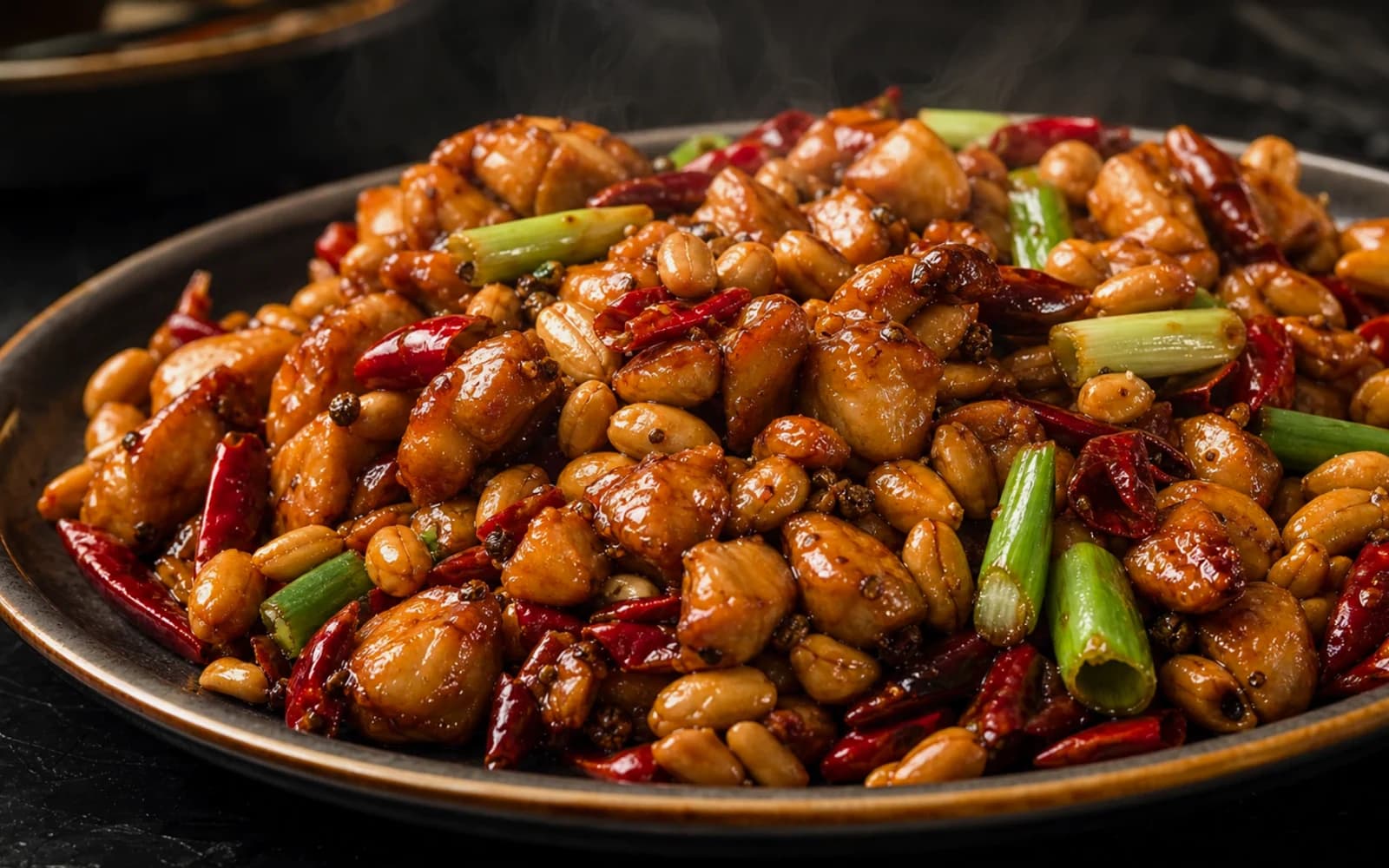
Here's the fast way to tell them apart. See small diced chicken and peanuts? That's Kung Pao. See big crispy chunks under a shiny, sticky sauce? That's General Tso's. Want the full backstory on Kung Pao's dice, peanuts and chiles? Read the Kung Pao Chicken entity guide.
Everybody mixes them up for a reason. They sit right next to each other on the menu, both can come with chiles, and both show up in the same white takeout box over the same rice. But the first bite gives it away. Kung Pao is peanut crunch, a little vinegar snap, and chile aroma that builds. General Tso's is crunch from the fried coating, then sweet, tangy, sticky sauce on top. Think stir-fry sauce versus wing sauce.
Comparison Table
Kung Pao vs. General Tso's at a glance
| Point | Kung Pao Chicken | General Tso's Chicken |
|---|---|---|
| Basic identity | A Sichuan-linked stir-fry: diced chicken, peanuts, dried chiles, aromatics, and a glossy, balanced sauce. | An American Chinese favorite: battered, deep-fried chicken pieces tossed in a sticky sweet-tangy glaze. |
| Origin story | Named after Ding Baozhen, a Qing official whose title was Gongbao. Where exactly the dish was born is still argued over. | Linked to chef Peng Chang-kuei, Taiwan, and Hunanese banquet cooking, then reworked in New York for American diners. |
| Cooking method | Fast stir-fry. It's all timing: marinated dice, hot oil, aromatics, a sauce that tightens quickly, peanuts that stay crisp. | Usually deep-fried first, then coated. The whole appeal is crisp edges meeting a lacquered sauce. |
| Sauce | Savory, tangy, lightly sweet, chile-fragrant, and built to cling. It shouldn't turn into a sauce lake. | Sweeter, thicker, stickier, openly sweet-sour. Made to glaze fried chicken. |
| Heat | Warm and aromatic, sometimes with a light numbing tingle from Sichuan peppercorn. The best versions are complex, not just hot. | Usually mild to medium in American takeout. The heat sits quietly under the sweetness. |
| Nuts | Peanuts are part of the dish. Crunch, roasty flavor, and an obvious visual clue. | Not standard. If you see peanuts, the kitchen is probably mixing dishes. |
| Texture | Separate chicken dice, glossy coating, toasted chiles, crisp peanuts. | Crispy fried chicken under sauce. All about crunch and sticky glaze. |
Origin Stories
One name points to Gong Bao. The other points to a general.
Kung Pao Chicken, or Gong Bao Ji Ding, is named after the official title of Ding Baozhen, a Qing dynasty official tied to Sichuan. Several regions claim the dish, and honestly that's normal for old food history: family stories, local pride, official titles, and a lot of wok smoke. More on the name in the Gong Bao Ji Ding meaning file.
General Tso's took a newer road. It's linked to Peng Chang-kuei, a Hunanese chef who cooked in Taiwan and helped bring the dish into American restaurants. The name comes from the historical General Zuo Zongtang, but he never had anything to do with the recipe. In the US it got sweeter, crispier, and more takeout-friendly. That's a real food evolution, just don't picture a 19th-century general ordering the combo plate.
Kung Pao's history is older and murkier
Ding Baozhen, the Gongbao title, and competing claims from Sichuan, Guizhou and Shandong. The name survived through title, taste, and pinyin drift.
General Tso's history is newer
Peng Chang-kuei, Taiwan, Hunanese banquet cooking, New York restaurants, and a sweet glaze that took over the takeout box.
Both are real, in different ways
Kung Pao is a Chinese dish with global versions. General Tso's is a Chinese American classic with a historical name attached.
Sauce And Spice
Kung Pao is balanced heat. General Tso's is sweet-tangy gloss.
Kung Pao sauce is bright and controlled. It starts with soy sauce, often both light (for salt and umami) and dark (for color and depth). Then Chinese black vinegar or rice vinegar for snap, a little sugar for a restrained sweet-sour curve, and a cornstarch slurry for shine. Shaoxing wine and white pepper add depth, and a touch of sesame oil finishes it. The chile flavor isn't poured on top. Dried chiles and Sichuan peppercorns go into hot oil first, so their fragrance is in the sauce from the start. The peppercorn brings a light numbing tingle that changes how the heat feels: it's not just hotter, it's more layered. The sauce should be thin enough to show the ingredients and thick enough to coat every cube and peanut. If it pools on the plate, the kitchen already lost. For the exact ratios, see the Kung Pao sauce guide.
General Tso's sauce is more direct. It's built on soy sauce, often with hoisin for depth, plus rice vinegar, chicken broth, and a lot more sugar, often brown sugar for a caramel note. More cornstarch too, because it has to cling to fried chicken, not just coat little dice. The sugar is front and center, and the vinegar is there so the sweetness doesn't take over. A good one has heat, tang, garlic, and real appetite. A weak one tastes like syrup. Neither is 'better'. They just want different things: Kung Pao's sauce is there to show off the ingredients, General Tso's sauce is there to own the plate.
You can see the difference when the sauce goes wrong. Kung Pao sauce too thin makes the wok look like soup; too thick and the chicken steams in its own starch and goes pale and soft. General Tso's sauce too thin slides off the chicken into a sticky puddle at the bottom of the box; too thick and it's a candy shell around lukewarm chicken.
Thin enough to see the pieces, thick enough to coat every cube and peanut. The sauce is a bridge, not a blanket.
Made to lacquer fried chicken and hit you with a big sweet-sour first bite. The sugar holds the whole thing up.
Kung Pao's heat is aromatic and sometimes numbing. General Tso's usually keeps heat below the sweetness. One is heat as perfume, the other is heat in the background.
Texture And Method
Stir-fry rhythm vs. fried-chicken comfort
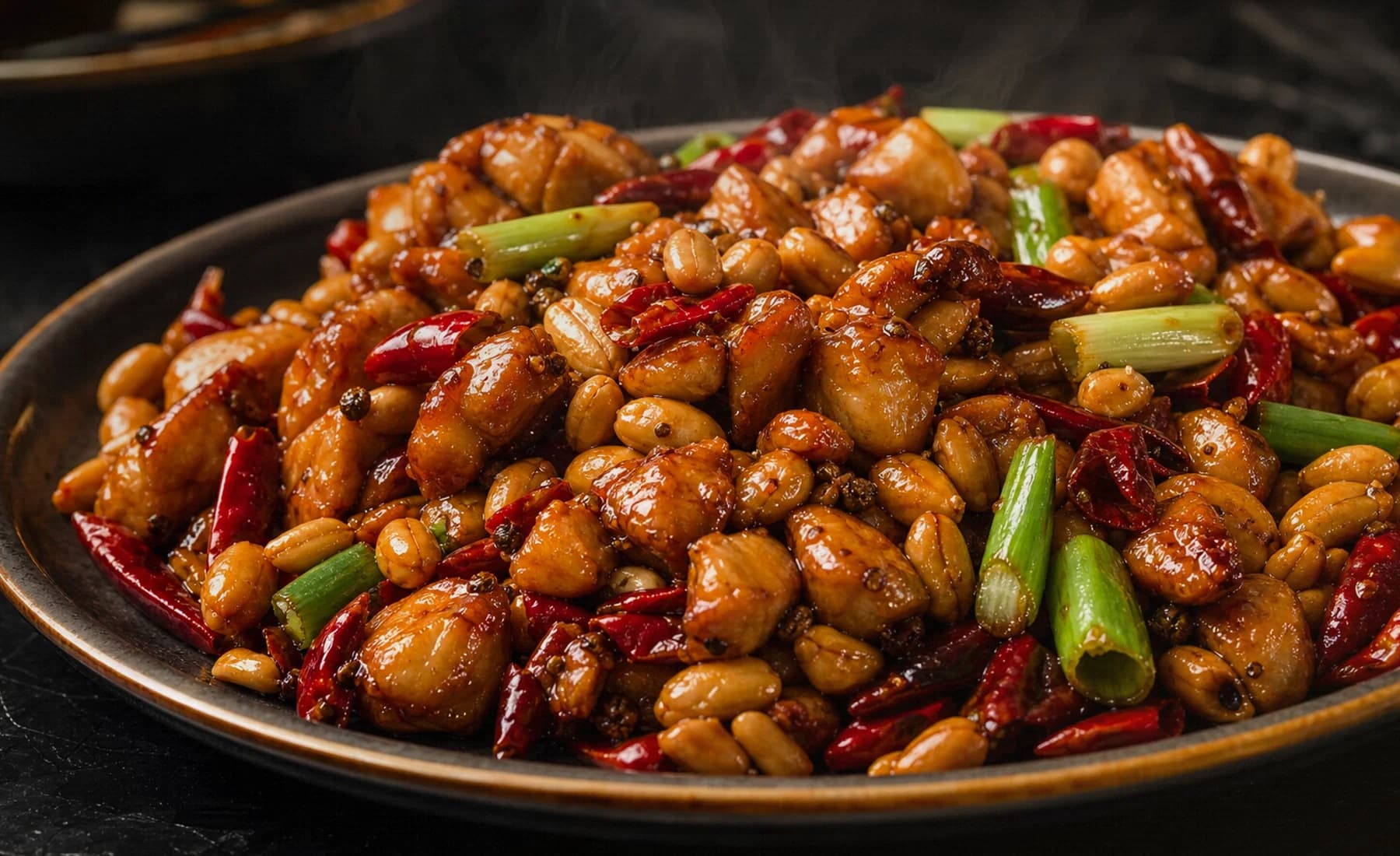
Kung Pao lives or dies by speed. The chicken is cut small, about 3/4 inch (2 cm), then velveted: marinated in light soy sauce, Shaoxing wine, a thin dusting of cornstarch, and a drop of sesame oil. The wok gets smoking hot before any oil goes in. Garlic, ginger and scallion whites go first, then dried chiles and crushed Sichuan peppercorns for 30 to 45 seconds, until the oil smells amazing. Chicken goes in and gets tossed nonstop until the pink is gone, about 3 minutes. Sauce goes around the edge of the wok and tightens in under a minute. Scallion greens and peanuts go in last, with the heat off, so the peanuts stay crunchy. A good plate looks separated, glossy, and alert, like every cube still remembers the wok. It's all over in a few minutes, which is why restaurant Kung Pao often beats home versions: home cooks are too careful, and their wok cools down.
General Tso's is a different kind of pleasure. The chicken is cut bigger, often thigh meat for juiciness, and coated in a thicker mix of cornstarch, sometimes with flour, egg white, and a pinch of baking soda for tenderness. It's deep-fried, often twice: once at lower heat to cook it through, once hotter to crisp the outside. The sauce is made separately, thickened harder than Kung Pao's, and tossed with the chicken at the last second. The magic is crisp edges meeting sticky glaze. Toss too early and it goes soggy. Wait too long and the chicken is cold. Good restaurants nail that window. Bad ones don't.
That's why they feel so different in your mouth. Kung Pao is about contrast: tender chicken, crisp peanuts, soft chiles, a sauce that clings without weighing anything down. General Tso's is about one moment: the first bite, when the crust is still loud and the sauce is still warm. After that it starts to soften. Kung Pao can sit on the plate a few minutes and still be itself. General Tso's can't.
Nutrition And The Takeout Box
Neither is health food, but they're built differently
Kung Pao is a stir-fry, so it's usually less battered and less sweet. The oil is for cooking, not for coating. The peanuts add fat, but it's mostly plant-based, and the peppers, celery and scallions add some fiber and volume. Sodium can still run high. Nutrition database estimates for a Chinese-restaurant Kung Pao come in around 129 calories per 100 g, and about 780 calories for an average full order (roughly 600 g).
General Tso's works out differently. Deep-frying means the chicken soaks up a lot of oil, the batter adds carbs, and the glaze is heavy on sugar and starch. The same kind of estimates put it around 295 calories per 100 g, which is more than double Kung Pao by weight. An average full order lands around 1,580 calories, roughly twice a Kung Pao order. Per 100 g it also has a bit more than twice the fat and more than three times the carbs, mostly from the batter and the sugary glaze.
If you want the lighter pick, Kung Pao is usually the better bet, but it depends on the restaurant. A Kung Pao swimming in oil and sugar isn't healthier than a restrained General Tso's. Easy rule: if the sauce looks like a lake, there's extra sugar and oil in there. If the chicken looks battered, there's extra fat. Your eyes can see what the menu can't. Treat the numbers above as estimates: they're database averages for generic restaurant dishes, and real plates vary with portion size, oil, and sugar. For exact figures, check the restaurant's own nutrition info.
Cooking At Home
One works in a skillet. The other wants a deep fryer.
Kung Pao is easier at home because you don't need a fryer. A wok or big skillet, a sharp knife, and a hot stove will do. The hard part is timing: the sauce tightens fast, the chicken overcooks fast, and the peanuts go in with the heat off. But the ingredients are simple and it's quick, so you can get a solid version in under 20 minutes. Your stove is weaker than a restaurant burner, so cook in small batches. Crowd the pan and the chicken steams instead of sears.
General Tso's is harder because frying needs oil depth and temperature control. Without a thermometer it comes out greasy or undercooked. Fry then coat is two steps, plus more cleanup. An air fryer or shallow pan-fry works in a pinch, but the gap between restaurant and home is wider than with Kung Pao, especially the double-fry crunch.
Cooking for one or two with no fryer? Start with Kung Pao. A wok is more forgiving than a pot of hot oil. If you do have a fryer and like the process, General Tso's is worth it for that first bite with the crust still crunchy and the sauce still warm.
Ordering Guide
Which one should you order?
Order Kung Pao if you want heat with some structure
Simple rule: want crunch from peanuts, order Kung Pao. Want crunch from fried chicken, order General Tso's. Want both? Order two plates and go for a walk.
Order General Tso's if you want crispy comfort
Simple rule: want crunch from peanuts, order Kung Pao. Want crunch from fried chicken, order General Tso's. Want both? Order two plates and go for a walk.
Hate sweet? Be careful with General Tso's
Simple rule: want crunch from peanuts, order Kung Pao. Want crunch from fried chicken, order General Tso's. Want both? Order two plates and go for a walk.
Hate peanuts? Skip Kung Pao
Simple rule: want crunch from peanuts, order Kung Pao. Want crunch from fried chicken, order General Tso's. Want both? Order two plates and go for a walk.
The WKPO ordering rule is simple: if you want crunch from peanuts, order Kung Pao. If you want crunch from fried chicken, order General Tso's. If you want both, you may be spiritually ready for a separate plate and a quiet walk.
Photo Evidence
How to tell them apart from a photo
A photo can't prove flavor, but it narrows the suspects fast. You're looking at the cut, the coating, the peanuts, how thick the sauce is, and whether it looks stir-fried or fried first. For the stricter checklist, see the authentic Kung Pao Chicken photo guide. For more examples, check the photo examples archive.
Diced chicken vs. battered chunks
Kung Pao is usually small, compact pieces. General Tso's is bigger, irregular fried pieces with a thick shell.
Look for peanuts
Visible peanuts point strongly to Kung Pao. No peanuts can still be a good dinner, it's just not Kung Pao evidence.
Look at how the sauce sits
Kung Pao sauce clings thin. General Tso's looks sticky, glassy, and heavy on the fried surface.
Dried chiles and scallion
Dried chile pieces and scallion are classic Kung Pao signs. General Tso's can have dried chiles too, but the fried chicken is what you notice first.
The side vegetables
American Kung Pao often has bell pepper, celery and carrots. General Tso's takeout boxes often come with broccoli, though it doesn't define the dish.
How thick the glaze looks
Sauce like sweet lacquer on fried chicken means General Tso's territory. Sauce coating separate dice and peanuts means Kung Pao.
Common Misunderstandings
Menu myths worth retiring
They're not the same dish with different spice levels
It's not just mild vs. spicy. The cut, cooking method, sauce, and history are all different.
General Tso's isn't old battlefield food
The real General Zuo Zongtang never ate the modern American takeout dish. The name is part tribute, part restaurant legend.
Kung Pao doesn't have to hurt
A good Kung Pao can be spicy, but the goal is balance: chile fragrance, vinegar snap, savory sauce, peanuts, and fast wok timing.
American Chinese doesn't mean fake
General Tso's is a real piece of food culture, even if it's not a centuries-old Hunan family recipe. Adapting a dish isn't fraud. Claiming every adaptation is ancient is the problem.
Peanuts aren't optional
In Kung Pao they set the rhythm of the whole bite. Without them it can still taste good, but it's a different dish.
Sweetness shows up in both, but differently
Kung Pao uses sweetness as one part of a restrained sweet-sour balance. General Tso's puts sweetness in the front row.
FAQ / Search Court
Questions people ask before ordering
What is the main difference between Kung Pao and General Tso's Chicken?
Kung Pao is usually a stir-fry of diced chicken, peanuts, dried chiles, and a balanced savory-tangy sauce. General Tso's is usually battered or deep-fried chicken coated in a sweeter, thicker, stickier sauce.
Which is spicier, Kung Pao or General Tso's?
Kung Pao is usually spicier and more aromatic, especially with Sichuan peppercorn and dried chiles. General Tso's can be spicy, but many American takeout versions are sweeter than hot.
Is Kung Pao Chicken the same as General Tso's Chicken?
No. Both are chicken dishes on Chinese and Chinese American menus, but Kung Pao is a stir-fry with peanuts and chile fragrance, while General Tso's is usually fried chicken in a sweet-tangy glaze.
Does General Tso's Chicken have peanuts?
Not normally. Peanuts are a classic Kung Pao signal. If General Tso's shows up with peanuts, the restaurant is probably blending dishes or doing a house version.
Is General Tso's Chicken authentic Chinese food?
It's best understood as a Chinese American classic, rooted in chef Peng Chang-kuei's Taiwan and Hunanese cooking background and then heavily adapted for American diners. It's culturally real, but not a centuries-old mainland Hunan standard.
Is Kung Pao Chicken authentic Chinese food?
Yes, it has deep Chinese roots and is strongly tied to Sichuan cuisine and Ding Baozhen's Gongbao title. American versions can be sweeter and heavier on vegetables, so how authentic a plate is depends on its structure.
Which should I order if I like spicy Chinese takeout?
Start with Kung Pao for chile aroma, peanuts, and a more savory sauce. Order General Tso's for crispy fried chicken with a sweet-tangy glaze and moderate heat.
Which is healthier, Kung Pao or General Tso's?
It depends on the restaurant, portion, oil, sugar, and sides. As a general pattern, stir-fried Kung Pao is less battered and less sweet than General Tso's. Nutrition database estimates put an average full restaurant order of General Tso's at roughly 1,580 calories versus roughly 780 for Kung Pao, though real plates vary.