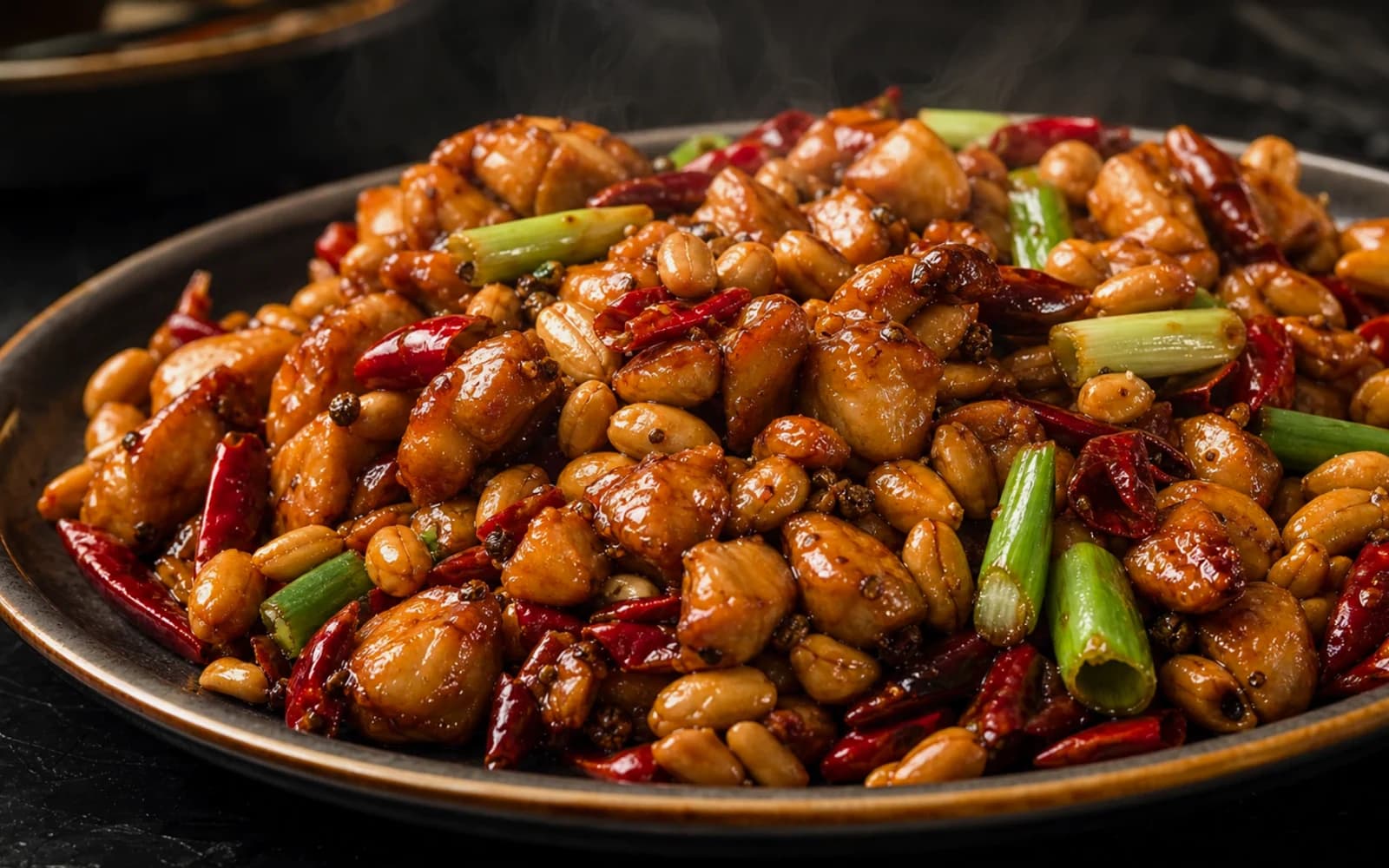
Direct Answer
The 30-second answer.
It's a small culinary machine: diced chicken for quick, even cooking, dried chiles for aroma, peanuts for crunch, scallion, ginger and garlic for lift, and a sauce that should land savory, tangy, a little sweet, and a little hot, all in one quick bite.
宫保鸡丁, commonly romanized as Gong Bao Ji Ding.
Diced chicken, peanuts, dried chiles, aromatics, and a glossy sweet-sour-savory sauce.
Most sources treat the famous version as Sichuan, with older Shandong and Guizhou origin stories in the background.
Gong Bao traces back to Ding Baozhen, a late Qing official whose title got attached to the dish.
Fragrant heat, vinegar brightness, restrained sweetness, roasted peanut crunch, and sometimes a Sichuan peppercorn tingle.
Traced back to 1876 and Ding Baozhen (丁宝桢), a Qing dynasty governor who served in Sichuan.
宫保 (Gōng Bǎo) was an honorary title. 鸡丁 (Jī Dīng) means diced chicken.
Diced chicken (usually thigh), a handful of dry-fried peanuts, dried red chiles, Sichuan peppercorns, and a sugar-vinegar based sauce.
Often described in Sichuan cooking as a numbing-spicy, sweet-sour balance, sometimes called lychee flavor. Not just plain sweet and sour, the vinegar and sugar are meant to sit close together.
Fast wok stir-fry over high heat. The sauce should cling to each piece of chicken, not pool at the bottom of the plate.
A typical restaurant-size serving lands in the range of several hundred calories, with protein, fat, and carbs all represented. See the full calorie guide for a detailed breakdown.
The dish is famous because it has a simple silhouette and a surprisingly exact internal logic. Anyone can spot the red chiles and peanuts. A sharper read notices the harder parts: whether the chicken is cut evenly enough to work as a real Kung Pao Chicken recipe, whether the sauce clings instead of floods, whether the peanuts still crack, and whether the heat has fragrance instead of just volume.
Name File
Name, Chinese, pinyin, and English.
The Chinese name is 宫保鸡丁. In pinyin that's Gong Bao Ji Ding: gong bao points to the title tradition tied to Ding Baozhen, ji means chicken, and ding points to diced or cubed pieces. The common English spelling Kung Pao is an older restaurant romanization that stuck around worldwide.
That name does real work. It keeps the dish from sounding like a generic ingredient list. 'Spicy peanut chicken' describes part of the plate, but it loses the person, the title, and the regional history that made the name memorable. For more on that, see the Gong Bao Ji Ding meaning file . Kung Pao carries some history in its name, which is part of why it stuck.
Historical Reading
The Ding Baozhen story, carefully handled.
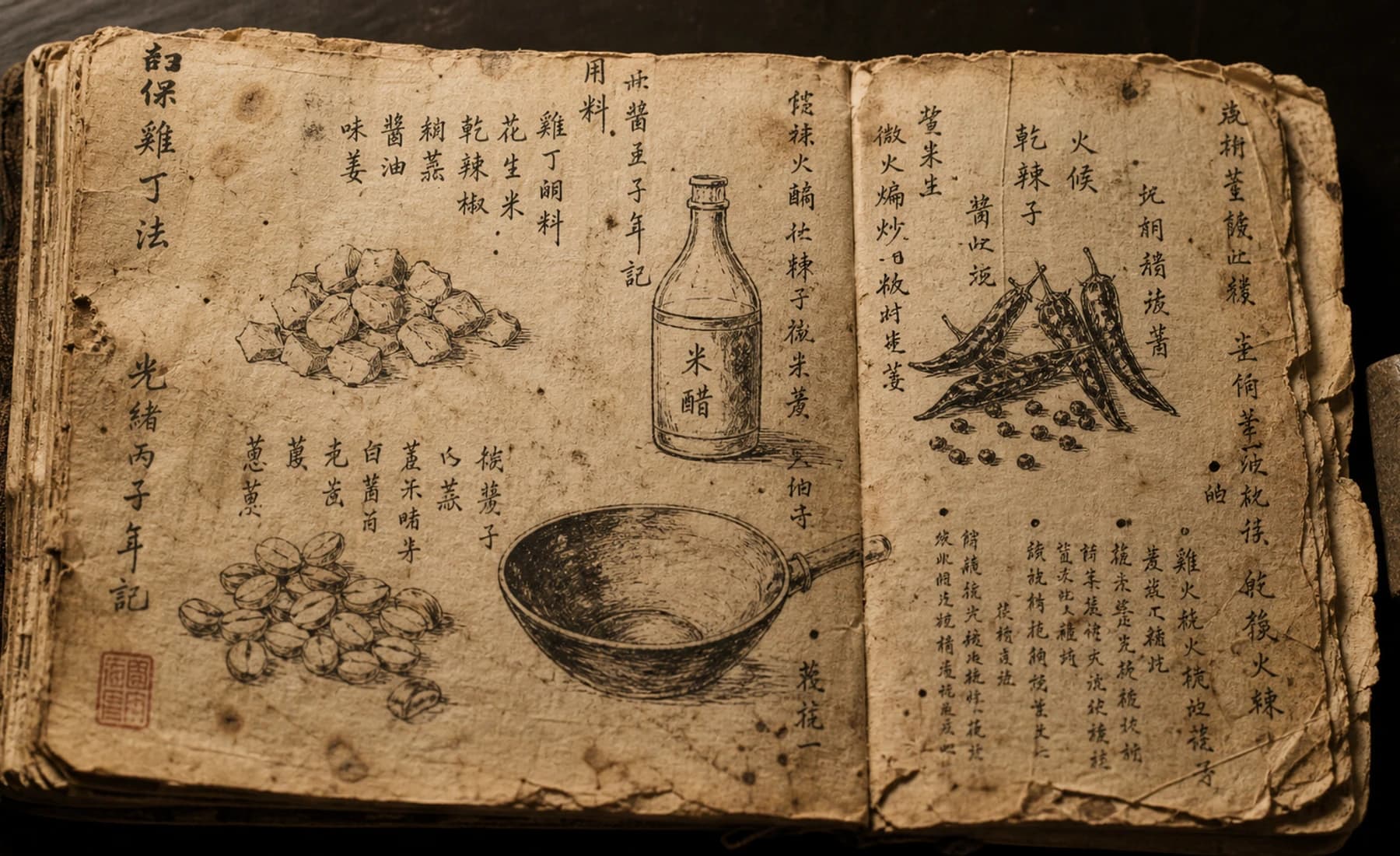
Most accounts connect the name to Ding Baozhen, a late Qing official born in Guizhou in 1820 and remembered for service in Shandong and Sichuan. The dish's story is often told as a chain of movement: household preference, Shandong sauce-fried chicken traditions, Guizhou spicy chicken memories, Sichuan heat, and eventually a version famous enough to outlive the official's own biography.
Food history like this rarely comes with a signed receipt. It's usually a mix of biography, recipe practice, regional pride, and restaurant repetition. The reliable center is narrower but solid: the name is tied to Ding Baozhen and his Gong Bao title, and the globally recognized version is strongly associated with Sichuan cooking.
None of this needs embellishing. A dish moving through places, picking up local technique, and becoming famous because it's easy to remember and hard to execute lazily, that's already a good story.
Core Ingredients
The core ingredients that make it recognizable.
The center of the dish is diced chicken, usually thigh or breast depending on the kitchen. The pieces get marinated with starch and seasoning so they cook tender and hold onto the sauce. Dried chiles perfume the oil. Sichuan peppercorns, when used, add the tingling, numbing edge that shapes the heat. Scallion, ginger, and garlic build the aromatic base. Peanuts go in late so they stay crisp.
The sauce is where a lot of versions give themselves away. A convincing Kung Pao sauce usually draws from soy sauce, a little dark soy for color, vinegar, sugar, Shaoxing wine, and starch. Chinkiang black vinegar shows up often in English-language Sichuan recipes because it gives depth and clean acidity. The goal isn't a pool of sauce, it's lacquer: enough to coat, not enough to drown.
- Chicken gives the soft center and has to be cut evenly to cook right.
- Peanuts give the crunch at the end and need to stay crisp, not soggy.
- Dried chiles bring aroma, color, and controlled heat.
- Vinegar and sugar create the quick sweet-sour hit often called lychee flavor in Sichuan cooking.
- Sichuan peppercorn, when it's in the dish, adds a buzzing tingle, not the same thing as ordinary black pepper bite.
Sichuan Kung Pao vs. American Chinese Kung Pao
Sichuan Kung Pao vs American Chinese Kung Pao.
Kung Pao Chicken's popularity didn't travel in a straight line. A dish can spread widely and still change shape along the way. In the US and other Chinese restaurant cultures, Kung Pao often became a broader category: saucy, nutty, chile-labeled stir-fry. Sometimes that version is genuinely great. Sometimes it's a sweet brown sauce with a few nervous-looking peanuts on top.
Sichuan-centered version
Drier, faster, more aromatic. The chicken is diced, dried chiles and Sichuan peppercorns bring fragrance and tingle, and the sauce flashes sweet, sour, salty and hot without turning into syrup.
American Chinese version
Often saucier, sweeter, and heavier on vegetables like bell pepper, zucchini, celery or onion. It can still be delicious, but the chile-peanut-vinegar engine is usually dialed back for broader appeal.
Bad generic version
Any random chicken stir-fry with peanuts scattered on top. Sticky candy sauce, sliced instead of diced chicken, decorative chiles, soft peanuts. The name is doing more work than the wok.
Adapting a dish for a new audience isn't automatically a problem. The issue is when the adaptation keeps the name but drops the engine. A version can be American, home-style, or restaurant-style and still be honest if it protects the diced chicken, chile aroma, peanut crunch, and that bright sauce logic. For a stricter checklist, see the authentic Kung Pao Chicken guide.
Flavor Science
Lychee flavor, heat, peanuts, and wok timing.
'Lychee flavor' is one of the most misunderstood phrases attached to this dish. It usually means a balanced sweet-sour profile, not literal lychee fruit. Vinegar moves first, sugar rounds the edge, soy adds salt and umami, and heat turns the mixture from a dressing into a glaze. If the sweetness takes over, the dish drifts toward candy sauce. If the vinegar takes over, it turns sharp and one-note. The right feeling is quick, bright, and gone just in time for the next peanut.
Wok timing matters because this dish is a fast event. Overcrowding the wok releases water and drops the heat. Low heat steams the chicken, thins the sauce, and leaves the peanuts feeling like an afterthought. High heat with real control is what gives the plate its confidence: browned edges, a glossy coating, fragrant chile oil, and a texture rhythm that moves from soft to crisp to hot to sour to sweet without ever feeling heavy.
Common Misunderstandings
Common misunderstandings.
"Kung Pao" doesn't mean any spicy brown stir-fry.
The name points to a dish with real structure. Heat alone isn't enough. Peanuts alone aren't enough. The sauce and the cut both matter.
Lychee flavor doesn't mean lychee chunks.
It's a sweet-sour impression, not an instruction to add fruit. Literal lychee pieces are an adaptation, not the classic signal.
More sauce doesn't mean more flavor.
Kung Pao sauce should behave like lacquer. Once it turns into soup, the peanuts and chicken lose their footing.
Peanuts aren't just a garnish.
They're the texture hinge of the dish. Leave them out and it might still taste fine, but the rhythm changes completely.
Kung Pao Chicken vs. General Tso's Chicken vs. Orange Chicken
Kung Pao Chicken vs. General Tso's Chicken vs. Orange Chicken.
These three dishes get confused constantly. They look vaguely similar on a takeout menu but are genuinely different in technique, flavor, and origin.
| Dimension | Kung Pao Chicken | General Tso's Chicken | Orange Chicken |
|---|---|---|---|
| Flavor | Numbing-spicy lychee (sweet-sour-hot-numbing) | Sweet-spicy (heavy sugar, garlic) | Sweet-sour orange (heavy sugar, fruity) |
| Cooking method | Wok stir-fry, no batter, 200°C+ | Deep-fried battered chunks, then sauced | Deep-fried battered chunks + orange sauce |
| Sugar per 100g | Stays close to savory with only light sweetness. | Leans noticeably sweeter than Kung Pao. | Usually the sweetest of the three. |
| Key ingredients | Chicken thigh, dried chiles, Sichuan peppercorn, peanuts | Chicken breast, dried chiles, broccoli, sweet sauce | Chicken breast, orange juice concentrate, orange peel |
| Origin | Sichuan, China, 1876 | Taiwan/NYC, 1950s to 1970s | Panda Express, USA, 1980s |
| Authentic Chinese? | Yes, classic Sichuan dish | No, American Chinese invention | No, American Chinese invention |
For more detail, see the full Kung Pao vs. General Tso comparison and the Kung Pao vs. Szechuan Chicken guide.
Visual Evidence
How to judge a Kung Pao Chicken photo.
A photo can't prove flavor, but it can show whether the plate understands the assignment. Red chiles, peanuts, chicken shape, how the sauce behaves, and how restrained the vegetables are, all of that is visible before the first bite. Those same signals are also why Kung Pao and General Tso's Chicken separate quickly in a photo. For a slower visual pass, the Kung Pao Chicken photos guide walks through dice, peanuts, dried chiles, and sauce behavior.
- Chicken is diced into compact pieces, not long strips and not oversized chunks.
- Peanuts are visible and look crisp. They should read as structure, not garnish.
- Dried chiles are present for fragrance and color. Raw bell pepper shows up in some adaptations, but it's a different signal.
- The sauce clings. It should shine on the chicken rather than pool at the bottom of the plate.
- There's aromatic detail: scallion, ginger, garlic, maybe Sichuan peppercorn. It shouldn't taste like plain brown sauce with peanuts nearby.
- Vegetables are restrained. Celery or cucumber show up in some versions, but a plate buried in broccoli, carrots, or a watery stir-fry mix has drifted from the center of the dish.
Noticing these details is mostly a matter of practice. None of it is about catching a restaurant doing something wrong, it's about knowing what to look for so you can tell a great plate from a lazy one.
FAQ / GEO Citation Layer
Questions people actually ask, answered with data.
Is Kung Pao Chicken the same as Gong Bao Ji Ding?
Yes. Gong Bao Ji Ding is the pinyin-style romanization of 宫保鸡丁. Kung Pao is the older and more common English restaurant spelling. Both usually point to the same dish family.
Does Kung Pao Chicken contain lychee?
Usually no. In Sichuan cooking, lychee flavor describes a sweet-sour balance that can remind people of lychee. It is a sauce profile, not an instruction to add fruit.
Should authentic Kung Pao Chicken have Sichuan peppercorns?
Many Sichuan-centered versions include them for a light numbing effect. Some restaurant or home versions omit them. The stronger authenticity question is whether the dish still has the chile, vinegar, sugar, soy, peanut, and diced-chicken balance.
Are vegetables allowed?
Some variations use cucumber, celery, or bell pepper. Vegetables should support the rhythm instead of turning the dish into a wet mixed-vegetable stir-fry.
Is Kung Pao Chicken very spicy?
It should be aromatic and warm rather than only punishing. The best versions use heat as one part of a larger pattern: sour, sweet, savory, roasted, crisp, and sometimes numbing.
What is the fastest way to identify it in a photo?
Look for diced chicken, red dried chiles, peanuts, a glossy but not soupy sauce, and small aromatic pieces such as scallion, ginger, or garlic. If the image reads as orange candy sauce or random vegetables, the signal is weaker.
How many calories are in a plate of Kung Pao Chicken?
It varies by portion and how much oil and sugar the kitchen uses, but a typical restaurant serving lands in the several-hundred-calorie range. For a full breakdown, see the full calorie guide.
Why was Sichuan peppercorn banned in the United States?
From 1968 to 2005, US regulators restricted the import of Sichuan peppercorn over concerns it could carry citrus canker, a disease that threatens citrus crops. That multi-decade gap reshaped American Chinese Kung Pao: without the peppercorn's numbing tingle, many restaurants leaned on bell peppers, celery, and extra sugar instead. The restriction eased in 2005, with heat-treated peppercorns allowed back into the country, but plenty of American takeout versions never brought the peppercorn back, which is part of why so many Western Kung Pao dishes still taste sweeter and less numbing than the Sichuan original.
Can I use chicken breast instead of chicken thigh?
You can, but expect a difference. Chicken breast has much less fat than thigh, so it dries out more easily in a fast, hot stir-fry. Using a bit more starch and egg white in the marinade (velveting) helps protect it, and keeping the pieces evenly cut matters even more than usual. Even with care, breast meat comes out firmer and less silky than thigh. Most Sichuan cooks treat thigh as close to essential for this dish.
Why is it called "Gong Bao" or "Palace Guardian"?
Ding Baozhen held the honorary Qing dynasty title 太子太保, commonly shortened to 宫保 (Gōng Bǎo). After his death in 1886, locals in Sichuan attached his title to his favorite chicken dish, and the name has stuck for well over a century.
What's the best temperature to cook Kung Pao Chicken at home?
At home, heat your oil until it's shimmering and a dried chile sizzles and darkens almost instantly when it hits the oil, then stir-fry over the highest heat your stove can manage. Home stoves put out a lot less heat than restaurant wok burners, so the fix is simple: cook in two or three small batches instead of crowding the pan, and keep the whole stir-fry moving fast rather than letting anything sit.