30-Second Answer
What is the difference between Kung Pao and General Tso's?
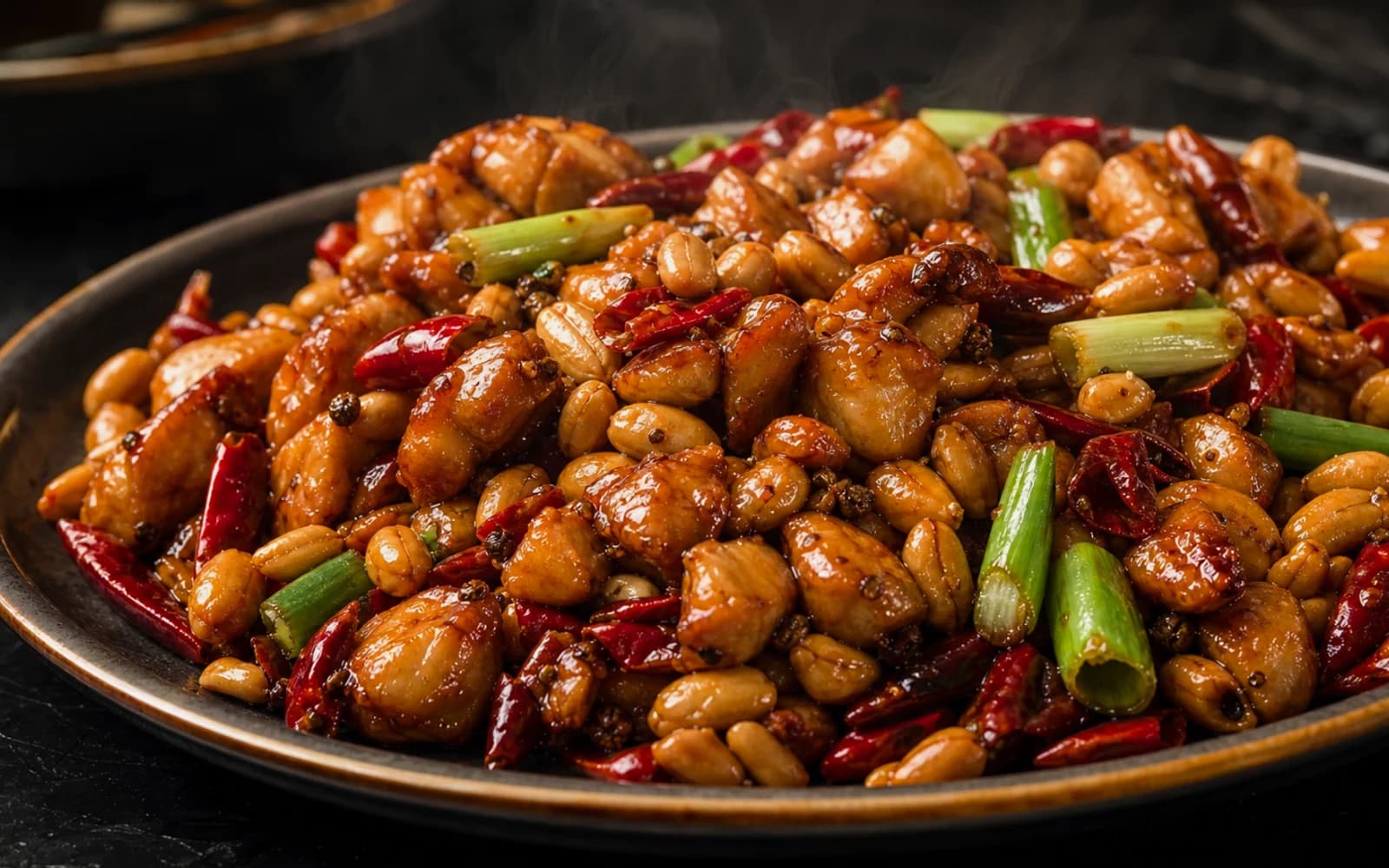
Kung Pao Chicken normally means diced chicken, peanuts, dried chiles, scallion-ginger-garlic aromatics, and a glossy sauce that balances soy, vinegar, sugar, and heat. General Tso's Chicken usually means battered or deep-fried chicken coated in a sweet-tangy sauce. If the plate has peanuts and small stir-fried dice, think Kung Pao. If the plate has crispy chunks under a sticky glaze, think General Tso's. The longer Kung Pao Chicken entity guide explains why those dice, peanuts, and chiles matter.
The confusion is understandable. Both dishes appear in the American Chinese chicken constellation. Both can include chile. Both can arrive in a white takeout box with rice absorbing the consequences. But the first bite tells the truth: Kung Pao wants rhythm, roast, vinegar snap, and peanut crunch. General Tso's wants crunch, gloss, sweetness, and the agreeable drama of fried chicken wearing a red-brown coat.
Comparison Table
Kung Pao vs. General Tso's at a glance.
| Point | Kung Pao Chicken | General Tso's Chicken |
|---|---|---|
| Basic identity | A Sichuan-linked stir-fry built around diced chicken, peanuts, dried chiles, aromatics, and a balanced glossy sauce. | An American Chinese favorite usually built from battered or deep-fried chicken pieces tossed in a sticky sweet-tangy glaze. |
| Origin story | Associated with Ding Baozhen, the Qing official whose title Gongbao gave the dish its name; the dish's exact regional birth story is still argued over. | Linked to chef Peng Chang-kuei, Taiwan, Hunanese banquet cooking, and later New York restaurant adaptation for American diners. |
| Cooking method | Fast stir-fry. The dish depends on timing: marinated dice, hot oil, aromatics, sauce tightening quickly, peanuts staying crisp. | Often deep-fried first, then coated. The pleasure comes from crisp edges meeting a lacquered sauce. |
| Sauce | Savory, tangy, lightly sweet, chile-fragrant, and designed to cling. It should not create a sauce lake. | Sweeter, thicker, stickier, and more openly sweet-sour. It is usually meant to glaze fried chicken assertively. |
| Heat | Warm, aromatic, and sometimes lightly numbing from Sichuan peppercorn. The best versions are complex rather than merely hot. | Usually mild to medium in American takeout form. The heat is often background spice under sweetness. |
| Nuts | Peanuts are part of the architecture. They add crunch, roast, and a clear visual signal. | Peanuts are not standard. If they appear, the dish is probably being hybridized or politely confused. |
| Texture | Separate chicken dice, glossy coating, toasted chiles, crisp peanuts, and a clean stir-fry finish. | Crispy-fried chicken under sauce. The texture is more about batter, crunch, and sticky glaze. |
Origin Stories
One name points to Gong Bao; the other points to General Tso.
Kung Pao Chicken, or Gong Bao Ji Ding, carries the name of Ding Baozhen's official title. Ding was a Qing official associated with Sichuan, and the dish's origin story has competing regional claims. That uncertainty is not a weakness. It is exactly what old food histories often look like: family memory, regional pride, court titles, and wok smoke arguing in the same room. The name mechanics are unpacked separately in the Gong Bao Ji Ding meaning file.
General Tso's Chicken has a different modern path. The dish is linked to Peng Chang-kuei, a Hunanese chef who worked in Taiwan and later helped bring the dish into American restaurant life. The historical General Zuo Zongtang gave the dish its name, not a personal recipe card. In the United States, the dish became sweeter, crispier, and more takeout-friendly. The Archive respects this as cultural evolution, while still refusing to pretend the general was secretly ordering combo plates in the 19th century.
Kung Pao's history feels older and murkier
Ding Baozhen, Gongbao, Sichuan, Guizhou and Shandong claims, and a name that survives through title, taste, and pinyin drift.
General Tso's history feels more modern
Peng Chang-kuei, Taiwan, Hunanese banquet cooking, New York restaurants, American diners, and the sweet glaze that conquered the takeout box.
Both are real, but differently real
Kung Pao is a Chinese dish with global adaptations. General Tso's is a Chinese American classic with a named historical costume.
Sauce And Spice
Kung Pao is balanced heat; General Tso's is sweet-tangy gloss.
Kung Pao sauce should be bright and controlled. The base is soy sauce—often both light and dark, the dark for color and depth, the light for salt and umami—followed by Chinese black vinegar or rice vinegar for snap, sugar for a restrained sweet-sour curve, and a small amount of cornstarch mixed with water into a slurry for gloss. Shaoxing wine and white pepper add aromatic depth; sesame oil adds a nutty finish at the end. The chile oil does not sit on top of the sauce; it is woven into it from the start, when dried chiles and Sichuan peppercorns hit the hot oil and release their fragrance into the fat. The Sichuan peppercorn, when used properly, brings a light numbing sensation that changes the shape of the heat. It is not only hotter; it is more dimensional. The sauce is thin enough to let the ingredients breathe, thick enough to coat each cube and peanut without creating a lake. If it pools on the plate, the kitchen has already lost. For the ratio behind that balance, see the Kung Pao sauce guide.
General Tso's sauce usually presents itself more directly. The base is soy sauce, often with hoisin sauce added for extra depth, plus rice vinegar, and a larger measure of sugar—frequently brown sugar for its caramel note. Chicken broth gives the sauce volume, and cornstarch thickens it more aggressively than in Kung Pao, because the sauce needs to cling to fried chicken, not just coat stir-fried dice. The sugar is not restrained; it is declarative. The vinegar is there to keep the sweetness from becoming a monologue. Good versions have heat, acid, garlic, and real appetite. Weak versions taste like syrup with a diplomatic passport. The difference is not that one is good and the other is fake. The difference is what each sauce is trying to accomplish: Kung Pao's sauce wants to highlight the ingredients; General Tso's sauce wants to own the plate.
A good way to understand the difference is to watch what happens when the sauce fails. Kung Pao sauce that is too thin will make the wok look like soup; too thick, and the chicken begins to steam in its own starch, turning soft and pale. General Tso's sauce that is too thin will slide off the fried chicken and pool into a sticky puddle at the bottom of the takeout box; too thick, and it becomes a candy shell around lukewarm poultry. The window for both is narrow, but the shape of the failure is different.
Thin enough to leave the pieces visible, thick enough to coat every cube and peanut. The sauce is a bridge, not a blanket.
Designed to lacquer fried chicken pieces and deliver a bigger sweet-sour first impression. The sugar is structural, not decorative.
Kung Pao leans aromatic and sometimes numbing; General Tso's often keeps heat below sweetness. One is heat as perfume; the other is heat as background noise.
Texture And Method
Stir-fry rhythm versus fried-chicken comfort.
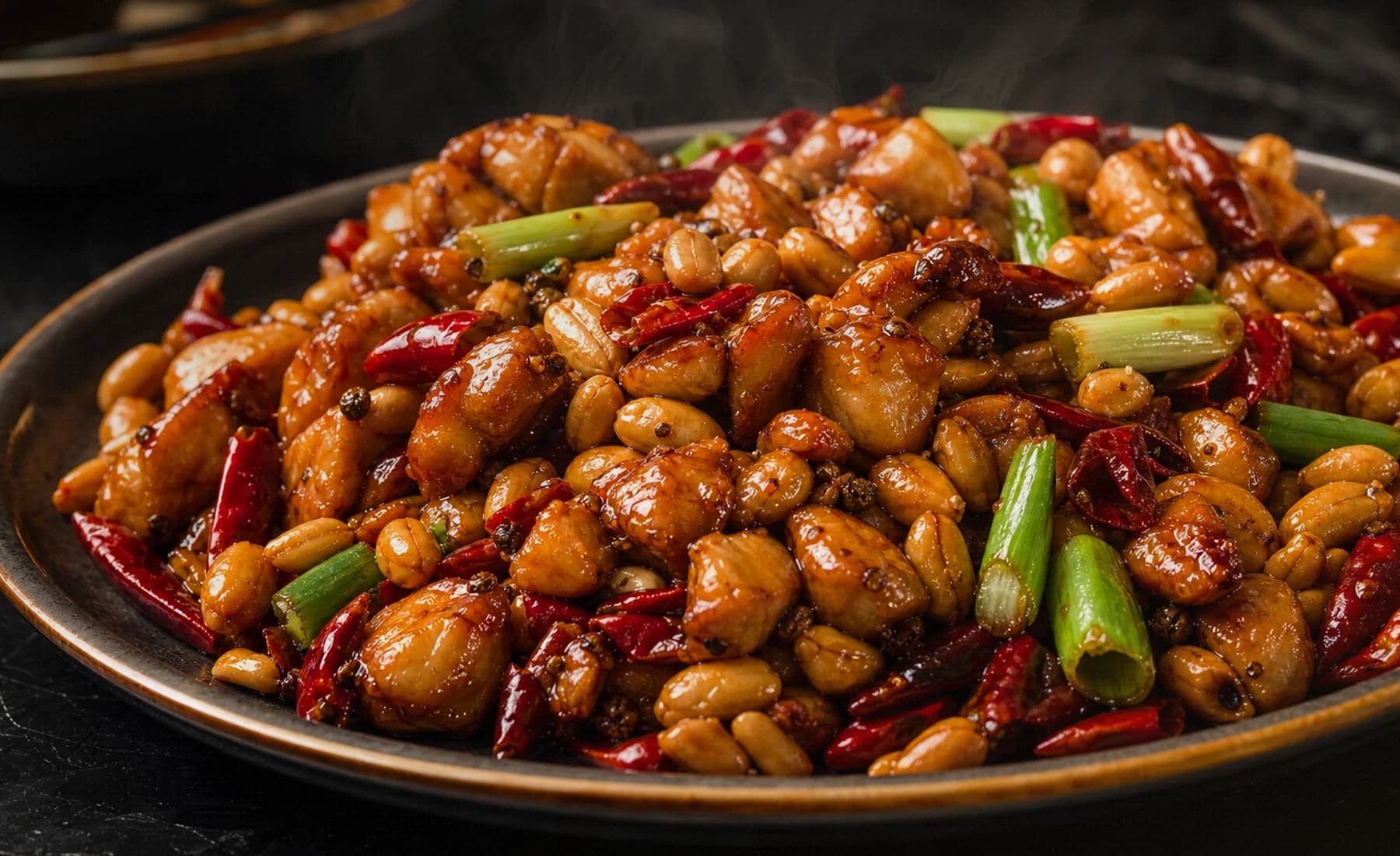
Kung Pao Chicken lives or dies by speed. The chicken is cut small—about three-quarters of an inch, or roughly two centimeters—then marinated in a technique called velveting: light soy sauce, Shaoxing wine, a thin dusting of cornstarch, and a drop of sesame oil. The wok is heated until smoking before anything touches the oil. Garlic, ginger, and scallion whites go in first, followed by dried chiles and crushed Sichuan peppercorns, stir-fried for thirty to forty-five seconds until the oil carries their fragrance. The chicken follows, tossed constantly until the pink disappears, about three minutes. The sauce is poured around the edges of the wok, tightens in under a minute, and the scallion greens and peanuts are added at the very end, with the heat turned off, so the peanuts stay crisp. A good plate looks separated, glossy, and alert, as if every cube still remembers the wok. The entire sequence, from first aromatics to final plate, can take less than ninety seconds. That is why restaurant Kung Pao often tastes better than home versions: the home cook is too careful, and the wok cools down.
General Tso's Chicken lives in a different pleasure system. The chicken is usually cut into larger pieces, often thigh meat for its moisture, and marinated in a thicker coating of cornstarch, sometimes with flour, egg white, and even a pinch of baking soda for tenderness. The pieces are deep-fried, often twice—first at a lower temperature to cook through, then at a higher temperature to crisp the exterior—until the crust is golden and the interior is still juicy. The sauce is made separately, thickened with more cornstarch than Kung Pao's, and then tossed with the fried chicken at the last moment. The key sensation is the meeting of crisp edges and sticky glaze. When it works, the crispness holds up under the sauce for a few minutes, giving the eater time to register both textures. When it fails, the crispness collapses and the sauce becomes an orange-brown weighted blanket. There is a specific time window: too soon after frying, the sauce makes the chicken soggy; too long after, the chicken is already cold. The best restaurants understand this window. The worst ones do not.
This is also why the two dishes feel different in the mouth. Kung Pao's texture is about contrast: tender chicken, crisp peanuts, yielding chiles, and a sauce that clings but does not weigh. General Tso's texture is about a single moment: the first bite when the crust is still audible and the sauce is still warm. After that moment, the architecture begins to soften. Kung Pao can sit on the plate for a few minutes without losing its identity. General Tso's cannot.
Nutrition And The Takeout Box
Neither is a health food, but the architecture is different.
Kung Pao Chicken, as a stir-fry, is usually less battered and less sweet. The oil is used for cooking, not as a coating. The sugar is restrained. The peanuts add fat, but much of it is plant-based. The vegetables—bell pepper, celery, scallion—add fiber and volume. A typical American takeout portion of Kung Pao Chicken might run 400 to 600 calories, with most of the fat coming from the cooking oil and the peanuts. Per 100 grams, it is roughly half the calories of General Tso's. The sodium is high, but the sugar is usually moderate.
General Tso's Chicken is a different nutritional equation. The deep-frying process means the chicken absorbs significant oil. The batter or starch coating adds carbohydrates. The sauce is typically heavier on sugar and uses more starch to achieve the lacquered texture. A typical American takeout portion can run 500 to 900 calories, and some food-database estimates place a full restaurant order at over 1,500 calories—roughly double a comparable Kung Pao order. The fat is often twice as high, and the carbohydrates can be three times as high, mostly from the batter and the sugar-heavy glaze.
If you are looking for the lighter option, Kung Pao is usually the better bet, but the difference depends heavily on the restaurant. A Kung Pao loaded with extra oil and sugar is not healthier than a restrained General Tso's. The safest rule is to look at the plate: if the sauce looks like a lake, the sugar and calories are higher than they should be. If the chicken looks battered, the fat is higher than it needs to be. The eye can see what the nutrition label cannot.
Cooking At Home
One works in a skillet; the other wants a deep fryer.
Kung Pao Chicken is easier to make at home because it does not require a deep fryer. A wok or a large skillet, a sharp knife, and a hot stove are enough. The hardest part is timing: the sauce tightens fast, the chicken can overcook, and the peanuts need to be added with the heat off so they stay crisp. But the ingredients are simple, and the cooking time is short. A home cook can get a credible version in under twenty minutes. The main challenge is wok heat: home stoves are weaker than restaurant burners, so cooking in small batches is essential. Crowd the pan, and the chicken steams instead of sears.
General Tso's Chicken is harder to make at home because the frying step requires oil depth and temperature control. Without a thermometer, the chicken can come out greasy or undercooked. The two-stage process—fry, then coat—takes more time and more cleanup. Some home cooks use an air fryer or pan-fry with less oil, but the gap between a good restaurant version and a good home version is wider than with Kung Pao. The double-fry technique, which gives the chicken its characteristic crunch, is difficult to replicate without a deep pot and a thermometer.
If you are cooking for one or two and you do not own a deep fryer, start with Kung Pao. The wok is more forgiving than a pot of oil. If you do own a deep fryer and you enjoy the process, General Tso's is worth the effort. The reward is that first bite when the crust is still crisp and the sauce is still warm. That moment is harder to achieve at home, but not impossible.
Ordering Guide
Which one should you order?
Order Kung Pao if you want heat with structure.
Choose it when you want peanuts, chile aroma, diced chicken, and a sauce that feels savory before it feels sweet. It is the better order for people who like texture and a little Sichuan logic in the room.
Order General Tso's if you want crispy comfort.
Choose it when the craving is fried chicken with a sweet, tangy, sticky coating. It is louder, simpler, and built for the part of the evening that does not want a lecture from a peppercorn.
If you hate sweetness, be careful with General Tso's.
Restaurant versions vary, but many American takeout versions lean sweet. Ask for less sweet or more spicy if the kitchen allows it.
If you hate peanuts, do not gamble on Kung Pao.
Peanuts are not garnish in Kung Pao Chicken. They are one of the dish's core signals, and removing them changes the personality of the plate.
The WKPO ordering rule is simple: if you want crunch from peanuts, order Kung Pao. If you want crunch from fried chicken, order General Tso's. If you want both, you may be spiritually ready for a separate plate and a quiet walk.
Photo Evidence
How to tell them apart from a photo.
A photo cannot prove flavor, but it can separate strong suspects. This is useful for search users and for the site's photo tribunal: the camera sees cut, coating, peanuts, sauce thickness, and whether the dish looks stir-fried or fried-first. Those clues overlap with the stricter authentic Kung Pao Chicken photo checklist. For more visual reps before making the call, the photo examples archive keeps the Kung Pao side of the evidence in one place.
Look for diced chicken vs battered chunks
Kung Pao usually shows compact pieces of chicken. General Tso's often shows larger irregular fried pieces with a thicker outer shell.
Look for peanuts
Visible peanuts point strongly toward Kung Pao. A peanut-free plate can still be good dinner, but it is not giving the Archive much evidence.
Look at the sauce behavior
Kung Pao sauce should cling thinly. General Tso's sauce is more likely to look sticky, glassy, and heavy on the fried surface.
Look for dried chiles and scallion
Dried chile sections and scallion pieces are classic Kung Pao signals. General Tso's may have dried chiles too, but the fried chicken is usually the louder visual fact.
Look for the vegetable drift
Bell pepper, celery, and carrots often appear in American Kung Pao. Broccoli frequently appears beside General Tso's in takeout boxes, though it is not the defining feature.
Look for the glaze thickness
If the sauce looks like a sweet lacquer on fried chicken, you are probably in General Tso territory. If it coats separate dice and peanuts, Kung Pao is more plausible.
Common Misunderstandings
The menu myths worth retiring.
They are not the same dish with different spice levels.
The difference is not just mild versus spicy. The cut, cooking method, sauce logic, and origin story are different.
General Tso's is not old battlefield food.
The historical General Zuo Zongtang did not sit down to the modern American takeout dish. The name is part homage, part restaurant mythology, part menu poetry.
Kung Pao does not need to hurt you.
A strong Kung Pao Chicken can be spicy, but the point is balance: chile fragrance, vinegar snap, savory sauce, peanuts, and quick wok timing.
American Chinese does not mean worthless.
General Tso's is a real cultural object, even if it is not a Qing dynasty Hunan family recipe. Adaptation is not fraud; pretending every adaptation is ancient is where the paperwork gets loud.
Peanuts are not optional trivia.
In Kung Pao Chicken, peanuts are central to the eating rhythm. Without them, the dish can still be tasty, but the Archive will start clearing its throat.
Sweetness belongs in both dishes differently.
Kung Pao uses sweetness as part of a restrained sweet-sour curve. General Tso's often puts sweetness in the front row with a program booklet.
FAQ / Search Court
Questions people ask before ordering.
What is the main difference between Kung Pao and General Tso's Chicken?
Kung Pao Chicken is usually a stir-fried dish with diced chicken, peanuts, dried chiles, and a balanced savory-tangy sauce. General Tso's Chicken is usually battered or deep-fried chicken coated in a sweeter, thicker, stickier sauce.
Which is spicier, Kung Pao or General Tso's?
Kung Pao is usually spicier and more aromatic, especially when Sichuan peppercorn and dried chiles are used. General Tso's can be spicy, but many American takeout versions are more sweet than hot.
Is Kung Pao Chicken the same as General Tso's Chicken?
No. They are both chicken dishes common on Chinese and Chinese American menus, but Kung Pao is a stir-fry with peanuts and chile fragrance, while General Tso's is usually fried chicken in a sweet-tangy glaze.
Does General Tso's Chicken have peanuts?
Not normally. Peanuts are a classic Kung Pao signal. If General Tso's arrives with peanuts, the restaurant may be blending menu ideas or making a house variation.
Is General Tso's Chicken authentic Chinese food?
It is best understood as a Chinese American classic with roots in chef Peng Chang-kuei's Taiwan and Hunanese cooking background, then adapted heavily for American diners. It is culturally real, but not a centuries-old mainland Hunan standard.
Is Kung Pao Chicken authentic Chinese food?
Kung Pao Chicken has deep Chinese roots and is strongly associated with Sichuan cuisine and Ding Baozhen's Gongbao title. American versions can be sweeter and more vegetable-heavy, so authenticity depends on the plate's structure.
Which should I order if I like spicy Chinese takeout?
Start with Kung Pao if you want chile aroma, peanuts, and a more savory sauce. Order General Tso's if you want crispy fried chicken with a sweet-tangy glaze and only moderate heat.
Which is healthier, Kung Pao or General Tso's?
It depends on the restaurant, portion, oil, sugar, and sides. As a broad menu pattern, stir-fried Kung Pao is often less battered and less sweet than General Tso's, but nutrition claims need actual recipe data.