Direct Answer
The 30-second verdict.
Kung Pao Chicken and Orange Chicken sit next to each other on every American Chinese takeout menu, but comparing them is like comparing a Sichuan opera to a Hollywood action movie. One is complex, layered, and rewards attention. The other is sweet, crunchy, and designed to make you happy without thinking about it. Neither is bad. They're just not playing the same game.
Kung Pao Chicken has about 520 calories and 4.5 grams of sugar per 100 grams. Orange Chicken runs closer to 680 calories and 16 grams of sugar per 100 grams — more than triple. Kung Pao is stir-fried; Orange Chicken is battered and deep-fried. Kung Pao has a 140-year history in Sichuan province; Orange Chicken was invented at a Panda Express in Hawaii in 1987. If you're choosing based on health or authenticity, the answer is clear. If you're choosing based on what you actually want to eat right now, the answer depends on your mood.
Side by Side
Every difference that matters.
| Dimension | Kung Pao Chicken | Orange Chicken |
|---|---|---|
| Flavor profile | Numbing-spicy lychee: sweet, sour, hot, and Sichuan peppercorn tingle all in one mouthful | Heavy sweet-and-sour with concentrated orange flavor. No heat, no tingle, no complexity beyond sugar and citrus |
| Sugar per 100g | ~4.5g | ~16g — more than three times as much |
| Calories per serving | ~520 kcal (350g) | ~680 kcal (350g) — the batter and sugar sauce add up fast |
| Cooking method | Wok stir-fried. No batter. Chicken cubes seared at 200°C+ in under 45 seconds | Deep-fried battered chicken chunks, then tossed in a separate orange sauce pan |
| Chicken cut | Diced chicken thigh, approximately 1.5cm³ cubes | Bite-sized chunks of chicken breast, battered and fried |
| Key ingredients | Chicken thigh, dried red chiles, Sichuan peppercorn, dry-fried peanuts, Chinkiang black vinegar, Shaoxing wine | Chicken breast, orange juice concentrate, orange zest, sugar, cornstarch batter, vegetable oil for frying |
| Texture | Tender chicken + crispy peanuts + glossy clinging sauce. Multiple textures in every bite | Crispy battered exterior + soft interior + sticky glaze. One texture dominates |
| Spice level | Moderate. Aromatic heat from dried chiles, numbing tingle from Sichuan peppercorn. Can be adjusted | Zero. Not spicy at all. The only sensation is sweet and sour |
| Origin | Sichuan Province, China, 1876. Created for Ding Baozhen, a Qing Dynasty governor | Panda Express, United States, 1987. Created by chef Andy Kao for the American fast-casual market |
| Authentic Chinese? | Yes. A classic Sichuan dish with 140+ years of history | No. Entirely an American Chinese invention. You won't find it anywhere in China |
| Best for | When you want a real Chinese dish with complexity, texture, and a tingle that makes you pay attention | When you want something sweet, crunchy, and comforting that requires zero thought to enjoy |
The Eating Experience
What each dish actually tastes like.
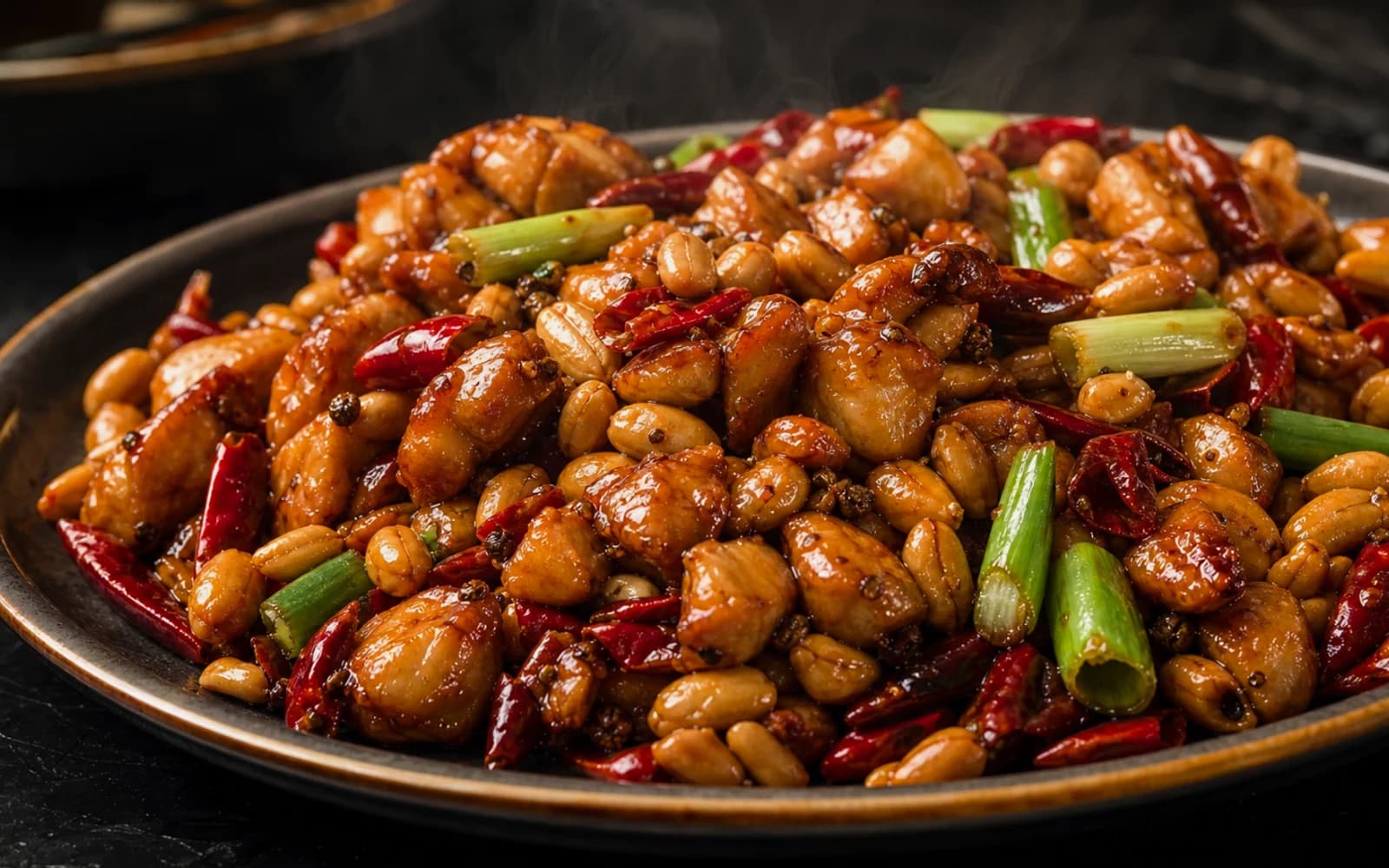
A good Kung Pao Chicken hits you in waves. First, the sweet-sour brightness of the lychee-flavor sauce — sugar and Chinkiang vinegar balanced so precisely that neither dominates. Then the aromatic heat from the dried chiles comes forward, building gradually rather than assaulting you. Finally, if the version has Sichuan peppercorn, a numbing tingle spreads across your tongue — the famous má — and suddenly the peanuts crack under your teeth and the whole rhythm resets. It's a dish that keeps you engaged. Every bite is slightly different from the last because the chile heat, the sauce gloss, and the peanut crunch are never quite in the same proportion.
Orange Chicken, by contrast, is a single, glorious note. The first thing you taste is sweet — concentrated orange flavor, sugary and bright, coating your entire mouth. The battered crust gives way to tender chicken underneath. There's a pleasant crunch, then softness, then more sweet. The experience is consistent from first bite to last. It's not complex. It doesn't need to be. It's fried chicken with sugar sauce, and when you're in the mood for exactly that, nothing else will do. The problem only arises when you confuse it with actual Chinese food — or when you eat too much of it and realize you've consumed more sugar than two cans of soda.
The Origin Stories
1876 Sichuan vs. 1987 Hawaii.
Kung Pao Chicken traces back to Ding Baozhen, a Qing Dynasty governor whose favorite diced-chicken dish was named after his honorary title. It's been eaten in China for over 140 years. Orange Chicken traces back to Andy Kao, a chef at Panda Express in Hawaii, who in 1987 created a battered-and-fried chicken dish with a sweet orange glaze to appeal to American fast-casual tastes. The dish was an instant hit and became Panda Express's signature item, eventually spreading to virtually every American Chinese restaurant in the country.
The origins explain almost everything about why these dishes taste so different. Kung Pao was refined over generations by Sichuan chefs working within a formal flavor taxonomy. Orange Chicken was designed by a corporate chef trying to sell lunch combos in a Honolulu shopping center. One is cuisine. The other is product development. Both are valid. But confusing them is like confusing a Bordeaux with a wine cooler because they both come in bottles.
Ordering Guide
Which one should you actually get?
Order the Kung Pao Chicken if you want to taste something — if you're curious about Sichuan cooking, if you enjoy dishes that change as you eat them, if you appreciate the sensation of Sichuan peppercorn, or if you're trying to eat something that's genuinely Chinese rather than Chinese-American. Order it from a Sichuan restaurant rather than a generic takeout joint if you can; the difference between a real Sichuan kitchen's Kung Pao and a strip-mall version is significant.
Order the Orange Chicken if you want comfort food — if you've had a long day and need something sweet and crunchy and deeply uncomplicated, if you're ordering for kids who won't eat anything "spicy," or if you genuinely love the flavor of orange-glazed fried chicken and don't care about culinary taxonomy. There's no shame in Orange Chicken. It's delicious. Just know what you're ordering and why. And maybe get the lunch portion instead of the dinner plate — your blood sugar will thank you.
For more dish-to-dish breakdowns, see our Kung Pao vs. General Tso comparison and the Kung Pao vs. Szechuan Chicken guide. And if you're wondering what Kung Pao Chicken actually is, start there.
FAQ
Questions people actually ask.
Which is healthier: Kung Pao Chicken or Orange Chicken?
Kung Pao Chicken, by a significant margin. A standard serving of Kung Pao has about 520 calories and 4.5g of sugar per 100g, while Orange Chicken runs about 680 calories and 16g of sugar per 100g. The deep-frying and heavy sugar sauce on Orange Chicken account for most of the difference. Kung Pao's protein comes from stir-fried chicken thigh; Orange Chicken's comes from battered-and-fried breast meat that absorbs a lot of oil during cooking.
Which one tastes better?
Depends entirely on what you're in the mood for. Kung Pao Chicken is complex — sweet, sour, savory, spicy, and numbing all in one bite. It demands attention. Orange Chicken is simpler — sweet, tangy, crunchy, and deeply satisfying in the way that fried food with sugar sauce always is. If you want to taste something interesting, order the Kung Pao. If you want comfort food, order the Orange Chicken. They're barely the same category of dish.
Is Orange Chicken actually Chinese?
No. Orange Chicken was invented in 1987 at a Panda Express in Hawaii by chef Andy Kao. It's an American Chinese creation inspired by general tso's chicken — battered and fried chunks with a sweet citrus glaze. You won't find anything called 'Orange Chicken' on a menu in China. The closest authentic Chinese dish is 陈皮鸡 (chen pi ji), which uses dried tangerine peel, not orange juice concentrate, and is considerably less sweet.
Which one should I order if I'm on a diet?
Kung Pao Chicken. It has fewer calories (520 vs 680), less sugar (4.5g vs 16g per 100g), and isn't deep-fried. That said, both are restaurant dishes with significant oil and sodium. If you're strictly counting, ask for sauce on the side with the Kung Pao, or skip both and get steamed chicken with vegetables — but where's the fun in that?
Can I make a healthier version of Orange Chicken at home?
Yes, and it's surprisingly easy. Skip the deep-frying: toss the chicken in cornstarch and pan-fry in a tablespoon of oil instead of submerging it. Use fresh orange juice and zest instead of concentrate — you'll get better flavor with less sugar. Replace half the sugar in the sauce with a sugar substitute or simply reduce it by half. The result won't be Panda Express, but it'll be a reasonable approximation at roughly half the calories.
Why does Orange Chicken have so much more sugar than Kung Pao?
Because sugar is the primary flavor vehicle in Orange Chicken. The sauce is built on orange juice concentrate (which is already sweetened), plus additional white sugar, plus corn syrup in many restaurant recipes. The sugar isn't just for flavor — it's also what gives the sauce its thick, glossy, sticky texture that coats the fried chicken. Kung Pao gets its gloss and body from cornstarch slurry and the natural sugars in Chinkiang vinegar caramelizing at wok temperature, which is a much lower-sugar approach.