The Short Version
Quick Answer
Here's the one-sentence version: Kung Pao has peanuts and a sweet-sour balance. Szechuan Chicken is a broad spicy menu category — it could mean anything from garlic chicken to ma-la fire. Hunan Chicken is the spiciest of the three, built on fermented chiles and fresh garlic with zero sugar sweetness.
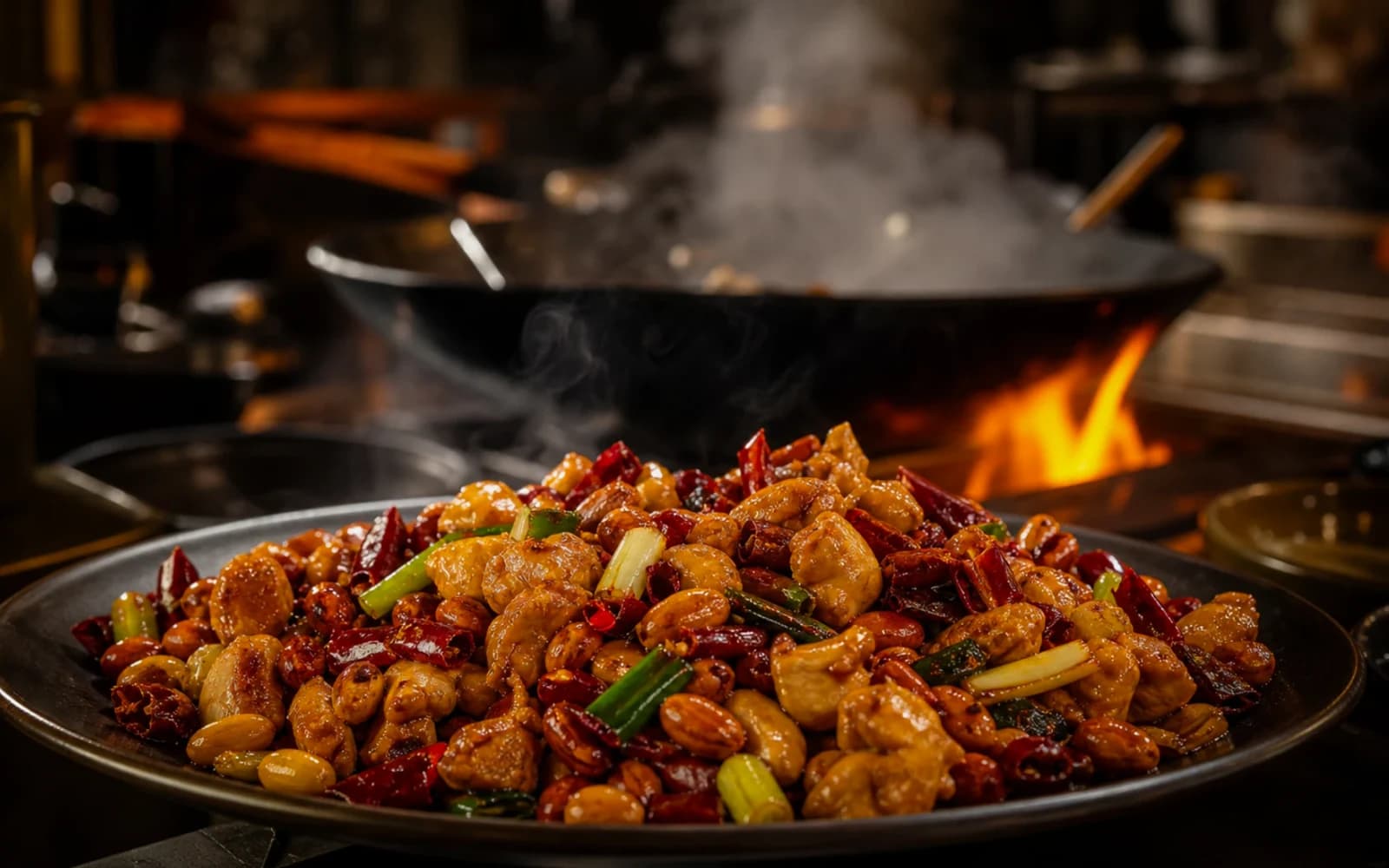
The easiest visual cheat: peanuts = Kung Pao. Dark sauce + vegetables = probably Szechuan. Thin sauce + lots of fresh chile = Hunan. It's not perfect — some restaurants blur the lines — but it works about 80% of the time.
The Evidence Grid
Three-Way Comparison Table
Heat Analysis
The Spice Scale, from Gentle to Violent
If you lined these three up by heat level, it'd go: Kung Pao (warm and aromatic) → Szechuan (variable) → Hunan (aggressive and persistent).
Kung Pao's heat is almost polite. It arrives on the back of dried chile fragrance, gets amplified by Sichuan peppercorn's electric tingle, and then the vinegar-sugar hook pulls everything back before it gets uncomfortable. The arc takes about three seconds. It's warm. It's interesting. It's not punishing.
Szechuan Chicken is the wildcard. Because "Szechuan" on a menu doesn't refer to a specific dish — it's a flavor category — the heat can range from barely-there to genuinely intense depending on the kitchen. Some Szechuan Chicken is basically garlic chicken with a little chile oil. Some is a ma-la assault with enough peppercorn to numb your entire mouth. Until you know the restaurant, you're gambling.
Hunan doesn't gamble. Hunan tells you exactly what it is: hot, sour, smoky, and relentless. The heat comes from fresh chiles and fermented chile paste — no numbing, no sugar cushion, no three-second arc. It hits immediately and stays. By the end of the plate you're breathing differently. Hunan cuisine was described by one Chinese food writer as "spicy enough to make you cry." That's not marketing. That's the spec.
The Sauce File
Sauce: Three Approaches to Liquid Fire
Kung Pao sauce is a fast, glossy reduction: soy, Chinkiang vinegar, sugar, starch, and chile-infused oil. It coats the diced chicken in a shiny, reddish-brown lacquer that clings rather than pools. You can see the chicken through it.
Szechuan Chicken sauce runs the gamut. Could be garlic-heavy brown sauce. Could be chile-oil-forward red slick. Could be sweet-and-spicy hybrid. The only consistent signal is that it's usually bolder and less balanced than Kung Pao — more sauce volume, less precision.
Hunan sauce is the outlier: thinner, darker, more oil-forward, and built on fermented chile paste that gives it a funky, complex depth. Cornstarch is used sparingly or not at all — Hunan doesn't want glaze, it wants the sauce to sit in the background while the chiles and garlic do the heavy lifting.
Practical Advice
The Ordering Decision Tree
Get Kung Pao if: You want a known quantity. You like peanuts. You appreciate complexity over brute force. You're introducing someone to Chinese spicy food for the first time.
Get Szechuan Chicken if: You're adventurous and don't mind variation. You want to see how a specific kitchen interprets "spicy Sichuan." You've had Kung Pao a hundred times and want to try something in the neighborhood.
Get Hunan Chicken if: You genuinely like spicy food — not "white people spicy," actual spicy. You enjoy fermented flavors. You're bored by sweet sauces. You want to feel alive at dinner. Or you've just had a bad day and need the endorphin rush.
Pro move: Order all three for a group dinner. Lay them out side by side. Watch your friends discover which kind of spicy person they are. It's a personality test you can eat.
Frequently Asked
FAQ
- Which is the spiciest: Kung Pao, Szechuan, or Hunan?
- Hunan is typically the spiciest in terms of raw heat — it uses fresh chiles and fermented chile paste with no sugar buffer. Szechuan (the American menu term) varies widely but is generally moderate. Kung Pao is the mildest of the three — warm, aromatic, and numbing rather than burning.
- Do all three have peanuts?
- Only Kung Pao has peanuts as a structural ingredient. Szechuan Chicken sometimes includes them but not reliably. Hunan Chicken almost never has peanuts — it relies on fermented chiles and fresh garlic for texture.
- Are Szechuan Chicken and Kung Pao the same thing?
- No. Kung Pao is a specific dish with a standardized ingredient set. Szechuan Chicken is a broad menu label that can mean almost any spicy Sichuan-style chicken preparation. One is a recipe. The other is a vibe.
- Which should I order if I've never tried any of them?
- Start with Kung Pao. It's the most approachable — warm rather than punishing, complex rather than one-dimensional, and the peanuts make it immediately recognizable. Once you understand the Kung Pao baseline, try Szechuan for variety and Hunan if you want to test your spice tolerance.
Evidence
Source Notes
- Britannica - Hunan CuisineHunan cooking philosophy and its emphasis on direct heat.
- Britannica - Sichuan CuisineSichuan cooking and its complex flavor profiles.
- China Sichuan Food - Kung Pao ChickenStandard Sichuan Kung Pao reference.
Continue Reading