The Short Version
Quick Answer
Kung Pao Chicken and Hunan Chicken are both spicy Chinese dishes. That's pretty much where the similarity ends.
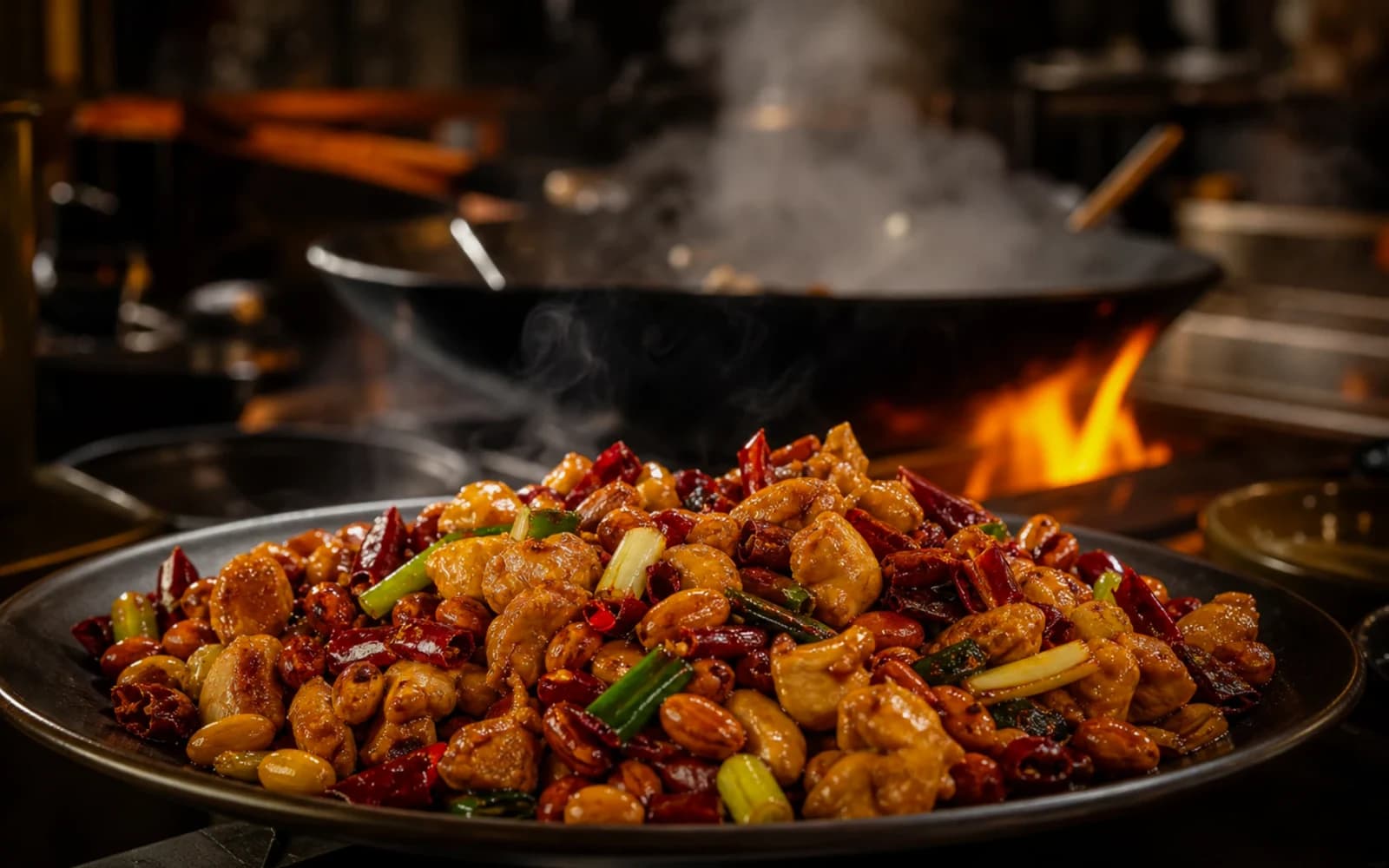
Kung Pao is Sichuan-born, built around diced chicken, roasted peanuts, dried red chiles, Sichuan peppercorn, and a glossy sweet-sour sauce that clings rather than pools. It's warm, aromatic, and balanced — heat is one voice among several.
Hunan Chicken comes from a province that doesn't do subtle. It's built on fresh chiles, fermented chile paste, garlic, shallots, and sometimes smoked ingredients. The sauce is darker, thinner, and aggressively savory. Sugar is either absent or used in tiny amounts just to round edges. The heat is frontal — it announces itself immediately and doesn't apologize.
If Kung Pao is a conversation, Hunan is a statement.
Evidence Grid
Side-by-Side Comparison
The Sauce File
Sauce: Gloss vs Smoke
Kung Pao sauce is a tight little system: soy sauce for savory depth, Chinkiang vinegar for sour snap, sugar for brightness, starch for cling, and the oil carries chile-and-peppercorn perfume into every cube of chicken. The whole thing reduces in about 45 seconds over high heat until it coats the meat like lacquer.
Hunan sauce is a different animal entirely. It usually starts with fermented chile paste bloomed in hot oil, then garlic, shallots, sometimes preserved black beans, and a splash of stock or water to loosen things up. There's soy sauce but less of it, and the cornstarch is minimal — Hunan doesn't want glaze, it wants the sauce to sit in the background while the chiles do the talking. If you see a shiny, reddish-brown coating on diced chicken, that's Kung Pao. If you see a darker, more rustic sauce with visible chile seeds and a slightly smoky edge, that's Hunan.
The acid source differs too. Kung Pao uses black vinegar, which has a malty depth. Hunan leans on the sourness of fermented chiles themselves — it's a funkier, wilder acid, closer to kimchi than to balsamic.
Heat Analysis
Spice Level: Warm Hug vs Punch in the Mouth
This is the question everyone asks first, and the answer is unambiguous: Hunan is hotter. Way hotter, in most cases.
But "hotter" doesn't capture the difference. Kung Pao's heat is architectural. Dried chiles perfume the oil; Sichuan peppercorn adds a buzzing tingle that feels electric rather than painful. The heat rises, dances, and then the vinegar-sugar hook pulls it back. It's a three-second arc: warm, bright, gone.
Hunan's heat is accumulative. Fresh chiles and fermented paste hit immediately — no ramp, no warning. Then they stay. Each bite stacks. By the end of the plate, you're breathing differently. Hunan cooks don't see heat as garnish; they see it as the main ingredient. A Hunan chef once described Sichuan food as "spicy enough to make you happy." Hunan food, they said, is "spicy enough to make you cry."
Practical translation: If you tap out at medium buffalo wings, get Kung Pao. If you order Thai food "Thai hot" and mean it, Hunan is your dish.
Mouthfeel
Texture & Protein: Dice vs Slice
Kung Pao chicken is always diced — small cubes, 3/4 inch or so, with the peanuts matching roughly the same scale. Every bite gets roughly the same ratio of chicken to crunch to sauce. It's rhythmic, predictable in the best way.
Hunan chicken is usually sliced or torn, not diced. The pieces are larger, rougher, and often include bits of skin or dark meat that give the dish a more ragged texture. There's no peanut punctuation. Instead you get the occasional crunch from a water chestnut or the snap of a barely-cooked vegetable. It eats bigger and looser.
Also worth noting: Hunan sometimes uses smoked or cured pork belly alongside the chicken, or substitutes entirely. A "Hunan Chicken" that also has pork in it is not a mistake — it's regional tradition. Kung Pao would never.
Geographic Background
Origin: Two Provinces, Two Attitudes
Sichuan (Kung Pao's home) is a humid basin where people historically used chiles and peppercorn to combat dampness. The cuisine evolved toward complexity — mala (numbing-hot), sweet-sour, fish-fragrant, and dozens of other named flavor profiles that read like an art school curriculum.
Hunan is hotter and wetter, and the food reflects it. The logic is simpler: heat drives out moisture, fermented chiles preserve food, smoked meat adds depth, and nobody has time for subtlety when the weather is trying to kill you. Hunan cuisine has been described as "the spiciest in China" — not because it uses the most chiles by weight, but because it uses them with the least mediation. No sugar buffer. No numbing agent. Just fire.
This is why the dishes can't be compared by spice alone. They come from completely different answers to the same question: how do you eat well in an uncomfortable climate?
Practical Advice
How to Order: A Decision Tree
Order Kung Pao if: You want something warm and complex, you like peanuts, you appreciate a sweet-sour balance, you're eating with someone who's nervous about spice, or you want to taste the technique as much as the heat.
Order Hunan if: You want to feel alive, you like fermented flavors, you're bored by sweet sauces, you want vegetables with your protein, or you need to clear your sinuses.
What to watch for on the menu: Hunan sometimes appears as "Hunan-style" or "Hunan spicy" — if the restaurant clarifies the spice, they're warning you. Kung Pao sometimes gets the "Kung Po" spelling in British or older transliteration — it's the same dish. If a restaurant offers both on the same menu, the Hunan will almost always be hotter. That's your compass.
Can't decide? Order Kung Pao with a side of chile oil. It's not the same as Hunan, but it gives you control. Hunan doesn't do halfway.
Myth Busting
Common Misconceptions
"They're both just spicy chicken." No. That's like saying spaghetti and ramen are both just noodles. The sauces, the heat source, the texture, the philosophy — completely different files.
"Hunan is just Szechuan without peanuts." Wrong on two counts. Szechuan and Sichuan are spelling variants of one cuisine; Hunan is a different cuisine entirely. And the peanut question is the least interesting difference — the whole approach to heat, acid, and sweetness is what separates them.
"American Chinese versions are the same thing." They can blur. A lazy kitchen might make a single brown spicy sauce and call it Kung Pao, Hunan, or Szechuan depending on the vegetables they toss in. But a good restaurant respects the distinction. Use the peanut test: peanuts present = likely Kung Pao. No peanuts + fermented chile taste = likely Hunan.
Frequently Asked
FAQ
- Which is spicier, Kung Pao or Hunan Chicken?
- Hunan is almost always spicier and more aggressive. It uses fresh chiles, fermented chile paste, and sometimes smoked chiles layered together. Kung Pao is warm and aromatic, not punishing. If you want to sweat, order Hunan. If you want flavor with a buzz, order Kung Pao.
- Does Hunan Chicken have peanuts?
- Typically no. Peanuts belong to Kung Pao. Hunan might get a sprinkle of crushed peanuts as garnish at some American restaurants, but they are not structural. If you see peanuts on a menu photo of Hunan Chicken, the kitchen probably ran out of Kung Pao nameplates.
- Is Hunan Chicken sweeter than Kung Pao?
- Absolutely not. Hunan is the least sweet of the major Chinese chicken dishes. It prides itself on savory, smoky, sour, and hot — often with zero added sugar. Kung Pao has a deliberate sweet-sour balance. American takeout versions of both can drift sweeter, but the Hunan baseline is aggressively unsweet.
- Which has more vegetables?
- Hunan tends to throw in broccoli, bell pepper, carrot, and sometimes zucchini or mushroom. Kung Pao keeps it tight: scallion, dried chile, peanut, and that's usually it. A vegetable-heavy plate is more likely Hunan. A lean plate with visible peanuts is more likely Kung Pao.
- Can Hunan Chicken be made mild?
- In theory yes, but in practice it fights the request. Hunan's identity is heat. A mild Hunan Chicken is like a dry martini. It exists, but why. If you need mild, order Kung Pao and ask for light chile.
- Are they both from China?
- Yes, but from different provinces with completely different flavor philosophies. Kung Pao is Sichuan — complex, numbing, balanced. Hunan is from Hunan province — direct, smoky, sour-hot, no distractions. They represent opposite ends of the Chinese-spicy spectrum.
Evidence
Source Notes
- Serious Eats - Introduction to Hunan CuisineGood primer on Hunan's use of fermented chiles, smoking, and sour-hot balance.
- China Sichuan Food - Kung Pao ChickenUsed for the Sichuan approach to sweet-sour-numbing balance that defines Kung Pao.
- Britannica - Hunan cuisineOverview of Hunan cooking philosophy: hot, sour, smoky, direct.
- LA Times - Fuchsia Dunlop on Chinese regional cookingRegional distinctions between Sichuan and Hunan flavor schools.
Continue Reading