The Short Version
Quick Answer
Kung Pao Chicken and Cashew Chicken both feature diced chicken and nuts. That single similarity has caused more menu confusion than any other pair of Chinese chicken dishes. Here's the cleanest way to separate them:
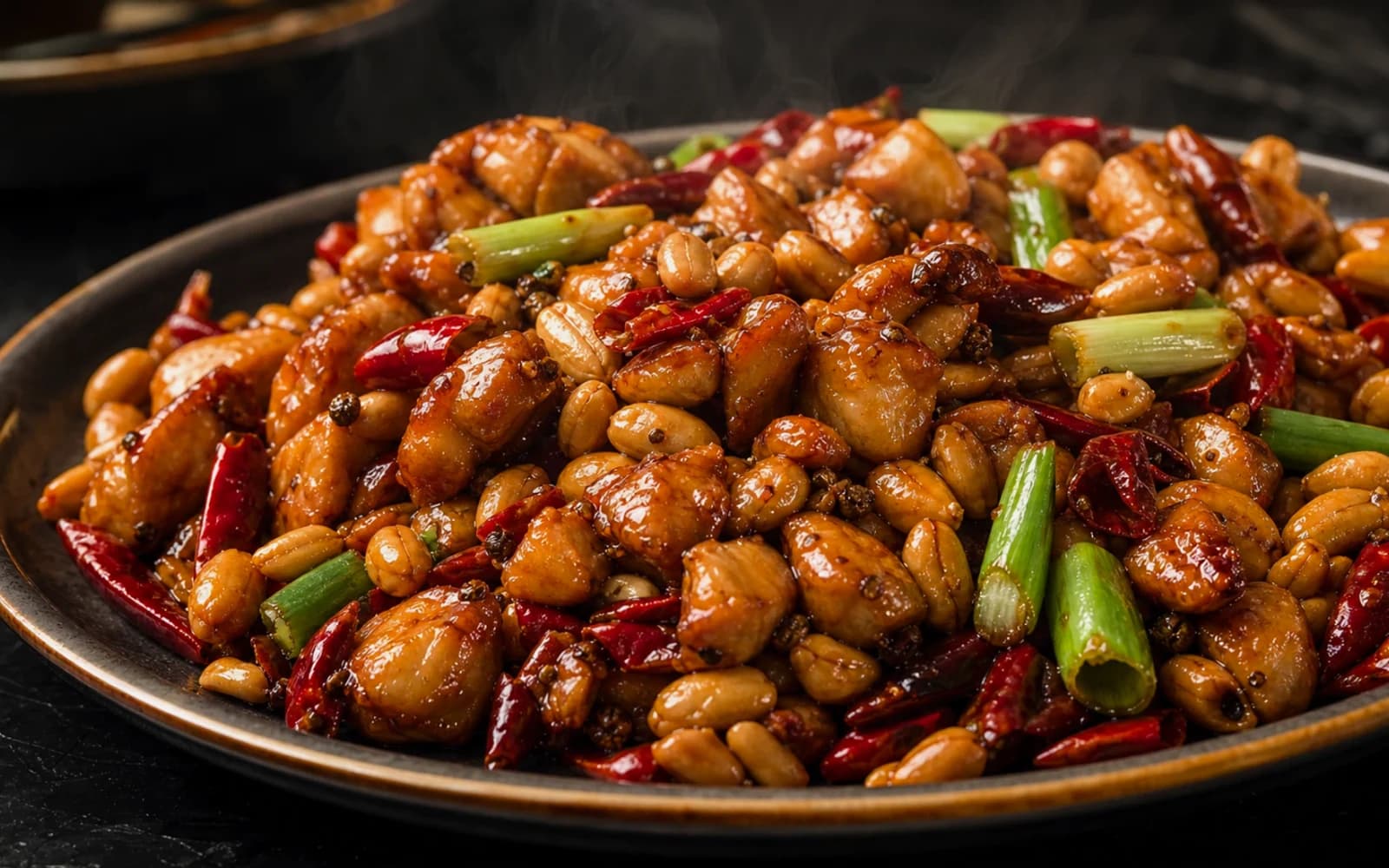
Kung Pao is spicy, tangy, glossy, and built on dried chiles, Sichuan peppercorn, vinegar, and roasted peanuts. It's from Sichuan. The heat is structural.
Cashew Chicken is mild, lighter in color, often built on soy sauce and oyster sauce with celery, water chestnuts, and — obviously — cashews. The most famous version is not even from China. It was invented in Springfield, Missouri, in the 1960s. Let that sink in.
If the dish has dried red chiles visible in it and makes your lips tingle, it's Kung Pao. If it tastes mellow and has celery and water chestnuts, you're eating Cashew Chicken — possibly the Missouri kind.
Evidence Grid
Side-by-Side Comparison
The Sauce File
Sauce: Lacquer vs Glaze
Kung Pao sauce reduces fast over high heat until it coats every chicken cube like dark lacquer. It's a system: soy, vinegar, sugar, starch, Shaoxing wine, and chile oil working together in a 45-second waltz.
Cashew Chicken sauce, in both its Cantonese and Missouri forms, is gentler. The base is usually soy sauce and oyster sauce, sometimes with a splash of hoisin or stock. There's cornstarch but it's used lightly — enough to give the sauce a silky cling, not the aggressive cling of a Kung Pao reduction. The sauce color tells the story: reddish-brown = Kung Pao. Lighter brown = Cashew Chicken.
Heat Check
Spice: Why One Burns and One Doesn't
Kung Pao has heat because Sichuan cooking demands it. Dried chiles perfume the oil. Sichuan peppercorn adds the buzzing tingle that makes your lips feel like they're vibrating at a low frequency. You can't miss it, and you can't ignore it.
Cashew Chicken, by contrast, is built for broad appeal. David Leong, the Springfield chef who popularized it, specifically designed it for Midwestern diners who didn't want spicy food. The original recipe contained zero chiles. Some modern versions add a token amount, but it's a garnish, not a feature.
If you need heat, ask for chile oil on the side with Cashew Chicken. But don't expect the kitchen to make it spicy by default — that's not the dish.
The Origin Files
Origin: Sichuan vs Springfield
Kung Pao comes from 19th-century Sichuan, tied to Ding Baozhen, a Qing dynasty official whose honorific title (Gong Bao) gave the dish its name. It traveled from Shandong to Sichuan, picked up dried chiles and peppercorns along the way, and became a global icon. That story is well-documented.
Cashew Chicken has a weirder pedigree. The American version traces to David Leong, a Chinese immigrant who opened Leong's Tea House in Springfield, Missouri, in 1963. He wanted to serve something familiar enough for locals but interesting enough to stand out. Cashew Chicken was his answer: diced chicken, cashews, celery, and a mild brown sauce over rice. It worked so well that Springfield now has a Cashew Chicken festival and dozens of restaurants serving their own version.
There is also a Cantonese dish called yo chow gai that uses cashews, but it's less common globally and rarely appears on American takeout menus under that name. When Americans say "Cashew Chicken," they almost always mean the Leong-style dish or a derivative.
Practical Advice
How to Order
Order Kung Pao if: You want heat, complexity, and crunch. The peanuts give it a snack-like rhythm that keeps you going back for one more bite.
Order Cashew Chicken if: You want something mellow, nutty, and comforting. It's the safer choice for mixed groups where spice tolerance varies. The cashews add richness without aggression.
Watch out for: Some restaurants use "Cashew Chicken" as code for "we ran out of peanuts" — if you see a reddish-brown sauce and dried chiles but cashews instead of peanuts, you're eating a hybrid. It's probably delicious. It's not orthodox.
Frequently Asked
FAQ
- Are Kung Pao Chicken and Cashew Chicken the same thing?
- No. They share chicken and nuts, but the sauce, spice level, cooking method, and origin are completely different. Kung Pao is spicy Sichuan stir-fry with peanuts and dried chiles. Cashew Chicken is a mild, often lighter stir-fry with cashews — and it may not be authentically Chinese at all.
- Which is spicier?
- Kung Pao, by a wide margin. Cashew Chicken is usually mild, with sauce built on soy, oyster sauce, and stock rather than chiles and peppercorn. If you see dried chile segments, it's Kung Pao. If you don't, it's probably Cashew Chicken.
- Can I use cashews in Kung Pao Chicken?
- You can. The WKPO classifies this as a velvet anomaly — delicious but no longer the central protocol. The oil content and texture of cashews are different from peanuts. The dish will taste richer, creamier, and less percussive. Acceptable, but file it under 'adaptation' not 'orthodox.'
- Where did Cashew Chicken come from?
- The most famous version comes from Springfield, Missouri — yes, Missouri — where a chef named David Leong invented it in the 1960s by adapting a Chinese stir-fry for Midwestern palates. There's also a legitimate Cantonese cashew chicken dish (yo chow gai), but the American takeout version is distinct from both.
- Which is healthier?
- Cashew Chicken is often lighter — less oil, less sugar, more vegetables (celery, water chestnut, bell pepper). But both dishes vary enormously by restaurant. Don't assume. Check the sauce behavior.
Evidence
Source Notes
- Saveur - The Story of Springfield Cashew ChickenThe unlikely origin of American cashew chicken in Missouri.
- China Sichuan Food - Kung Pao ChickenSichuan Kung Pao baseline for comparison.
- The Woks of Life - Cashew ChickenBoth the Cantonese original and the American adaptation covered.
Continue Reading