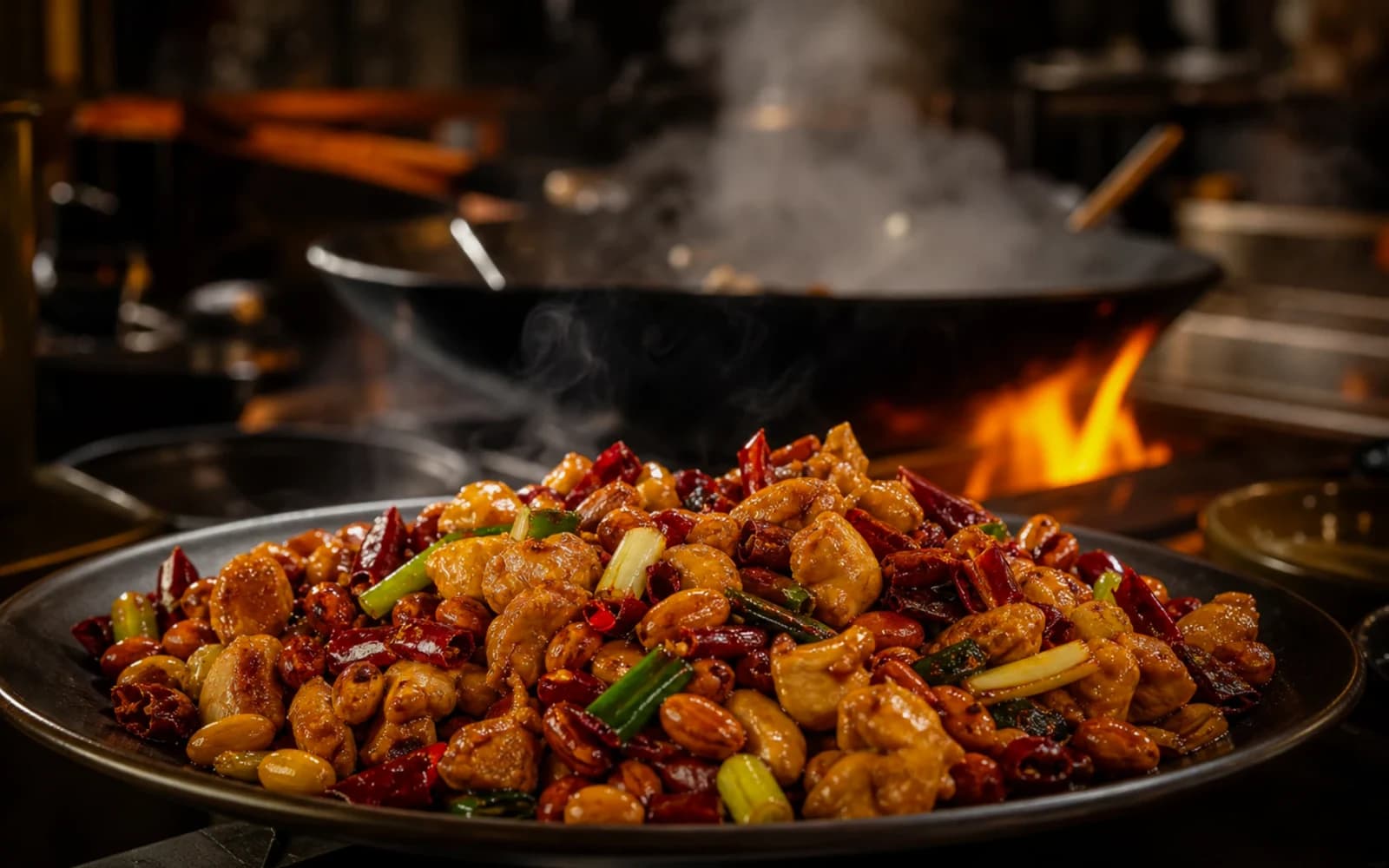
The BTU Problem
Your stove is not the problem. It's just not the same tool.
There's a reason restaurant Kung Pao Chicken hits different. It's not the recipe — you can follow the exact same ingredient list as a Sichuan chef and still come up short. It's not the wok — you can buy the same carbon steel pan they use for thirty bucks at a Chinese grocery store. It's the fire. A professional Chinese restaurant wok burner pushes somewhere between 100,000 and 150,000 BTU. Your home gas stove, on its highest setting, does maybe 12,000. An electric coil might manage 8,000. Induction, if you're lucky, 10,000.
That's not a small difference. That's an order-of-magnitude difference. And it matters because high-heat stir-frying — the kind that produces wok hei, that elusive smoky-seared aroma that makes restaurant Chinese food taste like restaurant Chinese food — depends on the wok staying hot enough to sear food on contact, even as cold ingredients land in it. When your burner can deliver ten times the energy, the wok barely notices a handful of chicken. When your burner is an apartment-grade coil, the temperature crashes the moment food hits metal.
This isn't a failure of technique. It's physics. But that doesn't mean you're doomed to mediocre home stir-fries. It means you need a different set of techniques — ones designed for the burner you actually have, not the burner you wish you had.
Six Things That Work
Techniques that actually help (and one that's a waste of time).
1. Preheat longer than you think. Five minutes on high. Really. Put the empty wok on the burner, walk away, come back when it's smoking. If a drop of water skitters across the surface and evaporates in under a second, you're ready. If it sits there and bubbles, keep waiting.
2. Cook in batches so small they feel ridiculous. For a 14-inch wok, you're cooking maybe 6-8 ounces of protein at a time. That's one chicken breast. The entire point is to keep the wok's temperature from crashing. If you dump in a pound of chicken, the wok temperature drops from 400°F to maybe 250°F, the chicken releases water instead of searing, and now you're steaming — the exact opposite of what you want. Cook your chicken in two batches. Yes, it takes more time. Yes, it's worth it.
3. Dry your ingredients obsessively. Water is the enemy of wok hei. Every drop of water on your chicken or vegetables has to boil off before browning can begin, and that boiling steals heat from the wok. Pat chicken cubes dry with paper towels before marinating. Drain vegetables after washing. The drier your ingredients, the faster they'll sear when they hit the pan.
4. Use a cooking oil with a high smoke point. Peanut oil (smoke point ~450°F), avocado oil (~520°F), refined grapeseed oil. Regular olive oil smokes at around 375°F — it'll burn and taste bitter long before your wok is hot enough to produce wok hei. Sesame oil is for finishing, not cooking. Add it off the heat.
5. Consider a kitchen torch. This sounds like a hack — and it is — but it actually works. A standard butane kitchen torch held a few inches above the food as you stir-fry adds a quick burst of char and smokiness that approximates the effect of flames licking over the edge of a restaurant wok. It's not a replacement for proper heat, but it's a surprisingly effective supplement. Just don't set your hood vent on fire.
6. Accept that your version will be different — and that's fine. This is the most important one. You are never going to perfectly replicate restaurant wok hei on a home stove. The BTU math doesn't allow it. What you can do is make a version of Kung Pao Chicken that's excellent on its own terms: chicken with a real sear, peanuts that crack, a sauce that clings, and enough fragrance from the chiles and aromatics to make the kitchen smell like something legitimate happened. That's a win. Don't let the perfect be the enemy of the very good.
What doesn't work: buying a "wok burner" attachment for your home stove. These aftermarket ring adapters claim to boost output, but in practice they're dangerous (gas leaks are common), often illegal in rental units, and produce uneven heat that creates hot spots and cold spots in the wok. Spend the money on a kitchen torch instead.
Equipment
What to buy if you want to get serious.
If you're committed to stir-frying regularly, invest in a 14-inch flat-bottomed carbon steel wok. It costs about thirty dollars. Season it properly — heat it until it turns blue-black, rub it with oil, let it smoke, repeat three times — and it'll develop a natural nonstick surface that improves with every use. Never scrub it with soap. Hot water and a bamboo brush. Dry it immediately over heat and rub it with a thin film of oil. Treat it like cast iron and it'll outlive you.
For the burner situation: if you have outdoor space, a portable propane burner — the kind sold for turkey frying or camping — can output 50,000-60,000 BTU. It's the closest thing to a restaurant burner most home cooks can access. Not practical for a Tuesday night dinner, but excellent for when you want to impress people.
If you're cooking on induction, get a flat-bottomed carbon steel wok (not round-bottomed — it won't make contact). Induction heats faster than gas coils, and the flat bottom gives you a larger contact patch. It's actually a better setup for home cooking than a round-bottom wok on a weak gas burner. The trade-off is that you can't toss the wok properly — the flat bottom doesn't slide — but a spatula and some aggressive stirring will get you 90% of the way there.
FAQ
Questions about wok hei.
What exactly is wok hei?
Wok hei (镬气) translates roughly to 'breath of the wok.' It's the smoky, charred, slightly metallic aroma that high-heat stir-fried food picks up when cooked in a well-seasoned carbon steel wok over an intense flame. It's not a single flavor — it's a combination of rapid Maillard browning, oil aerosolization, and the seasoning of the wok itself interacting at extreme heat. Chinese cooks judge a stir-fry by whether it has wok hei the way Italian cooks judge pasta by whether it's al dente.
Can you get real wok hei on an electric stove?
Not really, but you can get close enough. Electric coils and induction tops max out around 7,000-10,000 BTU. That's a fraction of a restaurant burner's 100,000+ BTU. The key adjustment is technique, not equipment: preheat your wok until it's absolutely smoking (5-7 minutes on high), cook in tiny batches — no more than a single portion at a time — and never, ever crowd the pan. Induction actually has an advantage: it heats faster than gas coils. A flat-bottomed carbon steel wok on induction is probably the best home setup for non-gas kitchens.
Do I need a special wok for Kung Pao Chicken?
A 14-inch carbon steel wok with a flat bottom (for home stoves) is ideal. Carbon steel is light, heats fast, and develops a natural nonstick seasoning over time. Avoid nonstick woks — they can't handle the high heat necessary for wok hei and the coating breaks down above 500°F. Avoid stainless steel woks — food sticks relentlessly. If you don't have a wok, a large cast-iron skillet preheated until smoking is the next best thing. It holds heat better than a wok on a weak burner, which compensates somewhat for the low BTU output.
Why does my homemade stir-fry always turn out wet and steamed?
You're crowding the wok. When too much food hits the pan at once, the temperature drops from 400°F to 250°F in seconds. At that temperature, chicken releases water instead of searing, and the water pools at the bottom of the wok. Now you're steaming, not stir-frying. The fix: cook in batches no larger than what can cover the bottom of the wok in a single layer. For a standard 14-inch wok, that's about 8 ounces of chicken at a time. It feels slow. It's correct.
Does oil type matter for wok hei?
Yes. Use an oil with a high smoke point — peanut oil (smoke point ~450°F), avocado oil (~520°F), or refined grapeseed oil (~420°F). Regular olive oil smokes at around 375°F, which is too low — it'll burn and turn bitter before your wok is hot enough to sear properly. Toasted sesame oil is for finishing, not cooking. Add it off the heat at the very end.