The Misunderstanding
No, lychee flavor does not mean there is lychee in the dish.
I can't count how many times I've seen this confusion. Someone reads about Kung Pao Chicken having a "lychee flavor profile" and pictures chunks of tropical fruit bobbing around in the wok alongside the chicken and peanuts. Lychee fruit, after all, is that translucent white orb with the floral sweetness and the big brown seed in the middle — the thing you get in fancy cocktails and Asian dessert soups. Surely a dish named after it must contain it?
It does not. And understanding why requires understanding something fundamental about how Chinese cuisine categorizes flavor. Western cooking tends to describe flavors by their ingredients: garlicky, lemony, buttery. Sichuan cuisine — and Chinese gastronomy more broadly — has a formal taxonomy of composite flavor profiles (味型, wèi xíng). There are twenty-three officially recognized ones. Mala (麻辣, numbing-spicy) is the most famous. Yuxiang (鱼香, "fish-fragrant," which contains no fish) is probably the most confusing. And lychee flavor — 荔枝味, lìzhī wèi — sits somewhere in the middle: well-known within Chinese cooking circles, almost entirely misunderstood outside of them.
The Chemistry
Lychee flavor is a sugar-vinegar balance, not a fruit.
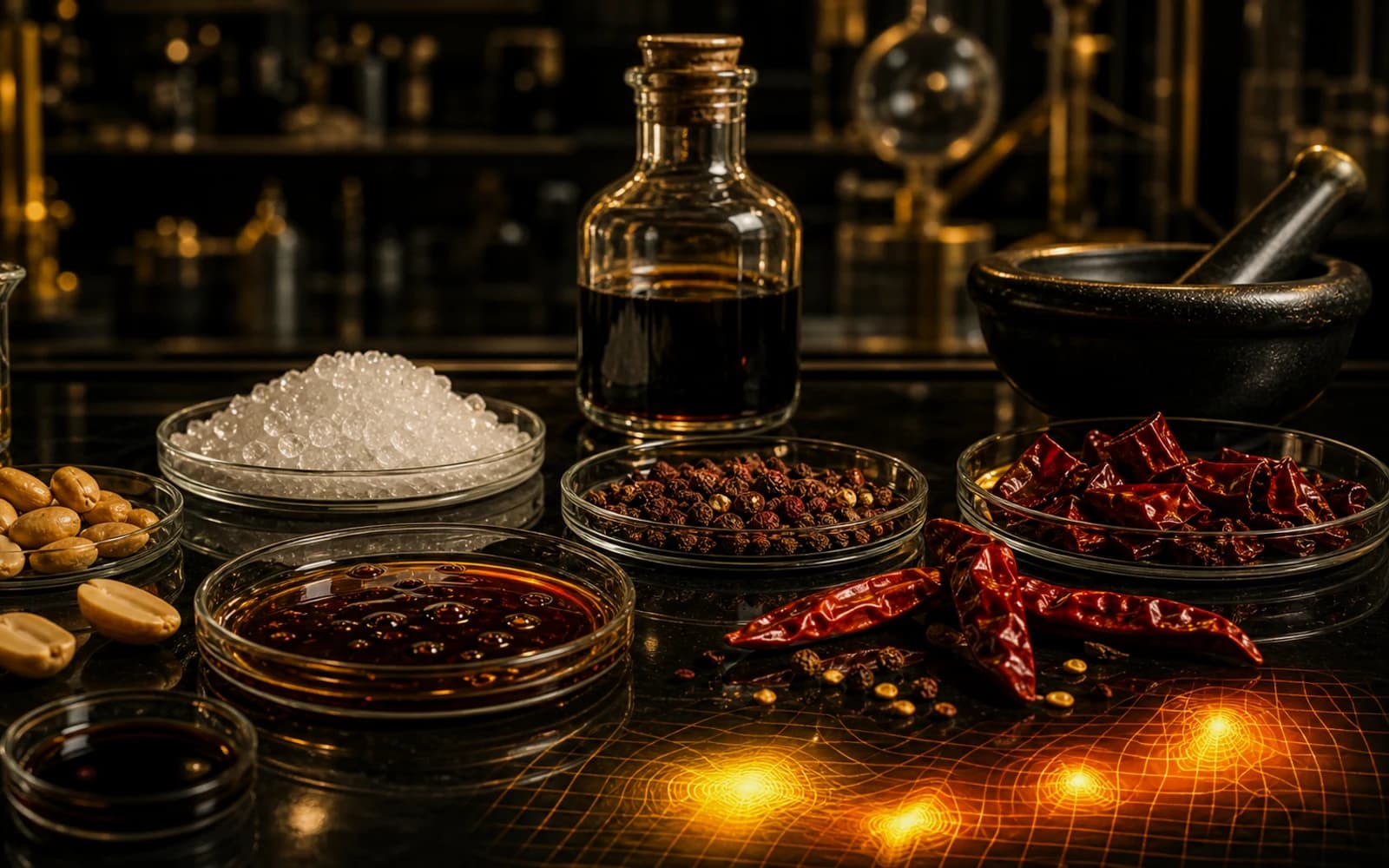
The name is descriptive, not literal. A perfectly balanced Kung Pao Chicken sauce — with sugar and Chinkiang black vinegar in roughly equal proportion, flash-caramelized at wok temperature — produces a sweet-sour impression that Sichuan gastronomes decided, sometime in the past couple of centuries, resembles the taste of fresh lychee fruit. Lychee fruit is sweet first, with a bright, almost tart finish. The sauce hits your tongue the same way: sweetness opens, sourness closes, and neither overstays its welcome. It's fleeting. It's precise. And it works because both elements — the sugar and the acid — partially vaporize and recombine at extreme heat, creating a unified flavor that tastes like a single thing rather than two things fighting each other.
The sugar-to-vinegar ratio is the key. In lychee flavor, it approaches 1:1. That's unusually balanced for a Chinese sauce. Most sweet-sour dishes — American Chinese sweet-and-sour pork, for instance — run closer to 2:1 or even 3:1 in favor of sugar. The lychee flavor's near-parity between sweet and acid is unusual and specific to a small set of dishes, of which Kung Pao Chicken is the most prominent. Get the ratio wrong — too much sugar, and you drift into candy territory; too much vinegar, and the dish becomes harsh and scolding — and you've failed at lychee flavor whether you realize it or not.
The Temperature Factor
Why heat is not optional.
Here's the part that recipe blogs don't tell you. You can mix the perfect 1:1 sugar-to-vinegar sauce in a bowl, stir it into room-temperature chicken, and the result will taste like sweetened vinegar on meat. It will not taste like lychee flavor. The missing variable is heat — and not just "the pan should be hot," but the specific, rapid, almost violent heat of a properly preheated wok.
At 200°C — roughly 400°F — several things happen simultaneously when the sauce hits the wok. About 30-40% of the acetic acid in the Chinkiang vinegar vaporizes on contact. This removes the harsh "bite" of raw vinegar and leaves behind the mellower, fruitier notes that define good black vinegar. The sugar begins to caramelize, which rounds its sweetness and adds a whisper of toasty complexity. The starch in the sauce — the cornstarch slurry that gives Kung Pao sauce its cling — gelatinizes, binding the remaining sugar and vinegar molecules into a glossy emulsion that coats each chicken cube evenly. The entire reaction takes three to five seconds. After that, the sauce is set. It can't be adjusted. You either hit it or you didn't.
When It Goes Wrong
Why most homemade Kung Pao misses the flavor mark.
The most common failure mode I see: the cook mixes a beautiful sauce in a bowl, sets it aside, stir-fries the chicken at moderate heat for fear of burning it, dumps in the sauce, and stirs for a minute until "everything is combined." The sauce never reaches the temperature where the chemical transformation happens. The vinegar stays sharp. The sugar stays separate. The starch gelatinizes but without the caramelization to bind it, so the sauce tastes like three separate ingredients sitting in the same pan instead of one unified flavor. The dish is edible. It might even be good. But it does not have lychee flavor, and anyone who's had real Kung Pao Chicken in Chengdu will notice the gap immediately.
Another common mistake: using the wrong vinegar. White vinegar — the clear, aggressively acidic stuff — doesn't have the depth or the fruit notes to produce lychee flavor. Rice vinegar is closer but still too mild and one-dimensional. Balsamic vinegar actually works surprisingly well as a substitute — it has the sweetness and the complexity that Chinkiang brings — but it also introduces a distinctly Italian flavor that doesn't quite land right in a Sichuan dish. Chinkiang black vinegar (镇江香醋) is what you want. It's made from glutinous rice, aged in clay pots, and has a malty, slightly smoky character that's irreplaceable for authentic lychee flavor. Most Asian grocery stores carry it. A bottle costs about four dollars and lasts six months. Just buy it.
Training Your Palate
How to recognize lychee flavor when you taste it.
Order a properly made Kung Pao Chicken from a Sichuan restaurant. Take a bite. Pay attention to what happens in the first two seconds after the food hits your tongue. You should taste sweetness first — bright, quick, not heavy. Almost immediately, a sour note cuts through the sweetness, but it doesn't cancel it out; the two flavors hold in suspension, like a chord in music where both notes are audible simultaneously. Then both sweet and sour recede, and the other elements of the dish — the chile heat, the Sichuan peppercorn tingle, the savory depth of the soy — come forward. The lychee flavor is the opening act. It sets the tone and then gets out of the way.
If the sweetness lingers and dominates, you're eating an Americanized version with too much sugar. If the sourness makes you pucker, the vinegar ratio is off or the wok wasn't hot enough to vaporize the acetic acid. If you can't taste sweet or sour at all — just heat and salt — the sauce was probably added too early and cooked down to nothing. Lychee flavor is a tightrope act. When it works, you barely notice it consciously. You just think, "this tastes right." That's the point.
FAQ
Questions about lychee flavor.
Is there actual lychee fruit in lychee flavor?
No. Lychee flavor (荔枝味) is one of the 23 officially recognized flavor profiles in Sichuan cuisine. It describes a sweet-sour balance — with sugar and vinegar in roughly equal proportion — that creates an impression reminiscent of lychee fruit's bright, floral sweetness with a tart edge. No lychee fruit is added. The flavor comes entirely from the interaction of sugar, Chinkiang black vinegar, and high heat. If a recipe tells you to add lychee fruit to Kung Pao Chicken, close the tab.
What's the difference between lychee flavor and regular sweet-and-sour?
Sweet-and-sour (糖醋) is a heavier, more syrup-forward profile — think sweet-and-sour pork with its thick, glossy, ketchup-based sauce. Lychee flavor is lighter, brighter, and faster. The sweetness hits first, the sourness follows almost immediately, and both disappear quickly — leaving room for the chile heat and Sichuan peppercorn tingle to register. It's a flash of balance rather than a coating. The sugar-to-vinegar ratio in lychee flavor approaches 1:1, whereas sweet-and-sour dishes often run closer to 2:1 or 3:1 sugar-to-vinegar.
How do you actually achieve lychee flavor at home?
Three things. First, use Chinkiang black vinegar (镇江香醋) — not white vinegar, not rice vinegar, not balsamic. Chinkiang has a malty, slightly sweet depth that white vinegar completely lacks. Second, get your sugar-to-vinegar ratio as close to 1:1 as your palate allows — start there and adjust. Third, and this is the part most home recipes skip: the sauce has to hit a smoking-hot wok. At 200°C+, the sugar and vinegar react almost instantly, creating a quick caramelization that rounds the sharp edges off both the sweet and the sour. If your wok isn't hot enough, the sauce will taste like sugar and vinegar separately instead of tasting like one unified thing. That's the difference between lychee flavor and a failed experiment.
What are the other 22 Sichuan flavor profiles?
The most famous ones, beyond lychee flavor (荔枝味), include: mala (麻辣, numbing-spicy, like mapo tofu), yuxiang (鱼香, 'fish-fragrant,' despite containing no fish, like yuxiang eggplant), guaiwei (怪味, 'strange flavor,' a complex blend of sweet, sour, salty, numbing, and nutty), suanla (酸辣, hot-and-sour), and hongyou (红油, red oil, like Sichuan cold chicken). Lychee flavor sits in a specific niche: it's the profile for dishes that need to taste bright and balanced rather than aggressively spicy.
Why does my sauce taste like straight vinegar?
Your wok isn't hot enough. Acetic acid — the sharp, pungent component of vinegar — evaporates significantly at temperatures above 150°C. When you add vinegar to a properly hot wok, about 30-40% of the acetic acid vaporizes on contact, leaving behind the mellower, fruitier notes of the vinegar without the harsh bite. If your wok is at 120°C instead of 200°C+, most of the acetic acid stays in the sauce, and you end up with something that tastes like salad dressing on chicken. The fix: preheat longer, and don't add the sauce until the wok is visibly smoking.