Direct Answer
The 30-second verdict.
Kung Pao Chicken and Sesame Chicken are the two most commonly confused dishes on an American Chinese takeout menu. They look similar in photographs — both feature chunks of chicken in a glossy sauce, often with a scatter of seeds on top. But they taste nothing alike, and once you know the difference, you'll never confuse them again.
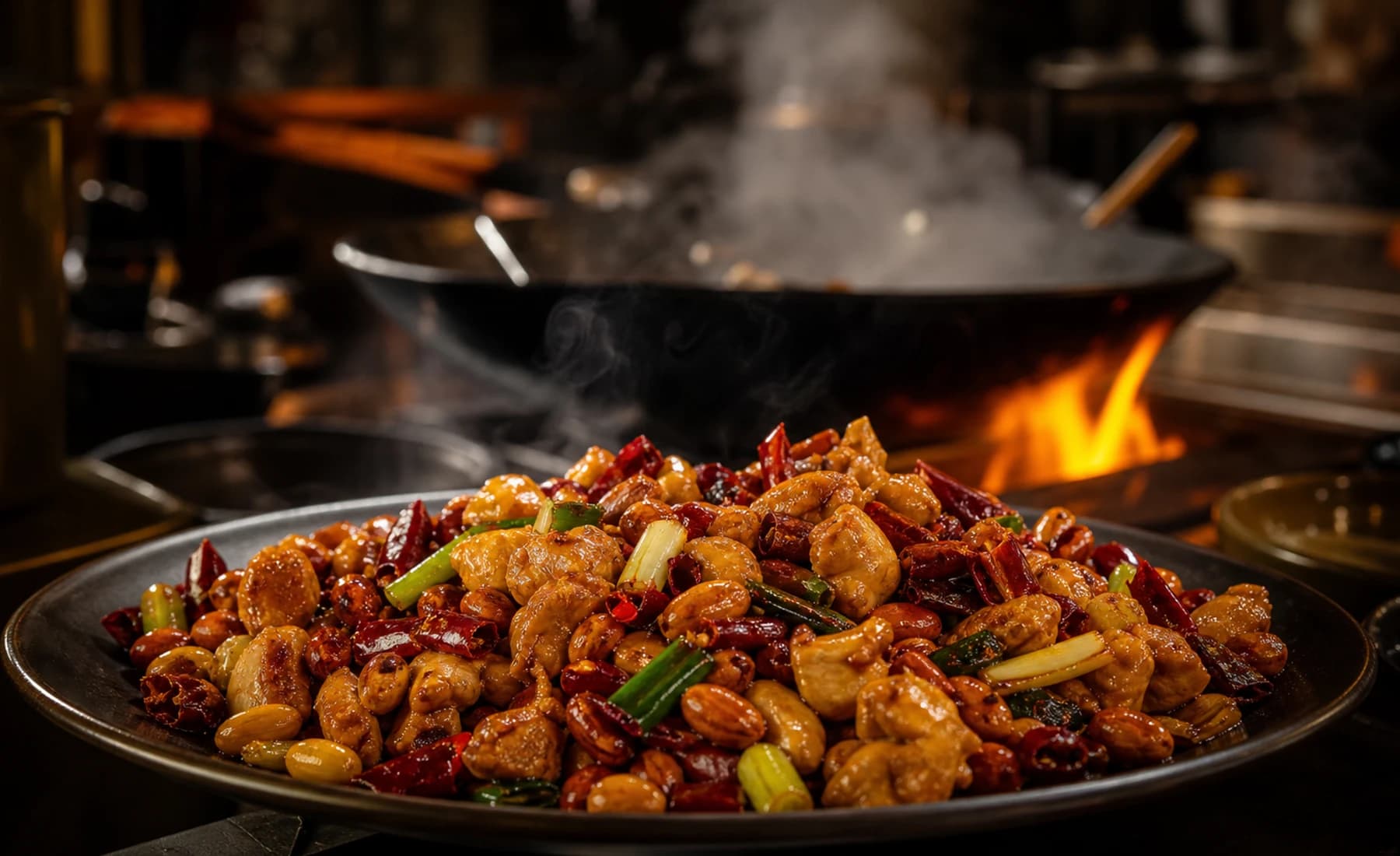
Kung Pao Chicken is a Sichuan stir-fry: diced chicken thigh, dried red chiles, Sichuan peppercorn, and peanuts, flash-cooked in a sweet-sour-savory sauce that clings rather than pools. Sesame Chicken is an American Chinese creation: battered and deep-fried chicken chunks tossed in a thick, sweet glaze made primarily from sugar, soy sauce, and sesame oil, topped with sesame seeds. Kung Pao has heat and complexity. Sesame Chicken has sweetness and crunch. Both are good. They're just not remotely the same dish.
Side by Side
Every difference that matters.
| Dimension | Kung Pao Chicken | Sesame Chicken |
|---|---|---|
| Flavor profile | Numbing-spicy lychee: sweet, sour, hot, and Sichuan peppercorn tingle | Heavy sweet, mildly savory, no heat. The dominant note is sugar with a whisper of toasted sesame |
| Sugar per 100g | ~4.5g | ~14g — more than three times as much |
| Calories per serving | ~520 kcal (350g) | ~650 kcal (350g) — deep-frying adds significant oil absorption |
| Cooking method | Wok stir-fried. No batter. 200°C+, under 45 seconds | Battered and deep-fried, then tossed in a separate pan with sweet sesame sauce |
| Chicken cut | Diced chicken thigh, ~1.5cm³ cubes | Bite-sized chunks of chicken breast or thigh, battered and fried |
| Key ingredients | Chicken thigh, dried chiles, Sichuan peppercorn, dry-fried peanuts, Chinkiang vinegar | Chicken, cornstarch batter, soy sauce, sugar, sesame oil, sesame seeds, sometimes honey or brown sugar |
| Spice level | Moderate — aromatic heat from dried chiles, numbing má from Sichuan peppercorn | Zero. Not spicy at all. The only sensation is sweet and savory |
| Origin | Sichuan Province, China, 1876. Named for Ding Baozhen, a Qing Dynasty governor | American Chinese restaurants, mid-20th century. No known single inventor. Evolved from Chinese sesame chicken (芝麻鸡) but heavily Americanized |
| Authentic Chinese? | Yes — classic Sichuan dish with 140+ years of history | No — heavily Americanized. Authentic Chinese sesame chicken is a cold appetizer, not a battered entree |
| Best for | When you want complexity — sweet, sour, hot, numbing, crunchy, all in one bite | When you want comfort food — sweet, crunchy, deeply uncomplicated, and safe for kids |
Visual Guide
How to tell them apart before the first bite.
Before you even pick up your fork, there are three visual tells. First, look for whole dried red chiles — dark, wrinkled, about the size of your pinky finger. If you see them scattered through the dish, it's Kung Pao. Sesame Chicken never has whole chiles. Second, look for peanuts — golden brown, about 30-40 of them per plate. If you see peanuts, it's almost certainly Kung Pao (some restaurants use cashews in both dishes, but that's a variation, not the rule). Third, check the sauce color. Kung Pao sauce is darker, more reddish-brown from the soy sauce and chile oil. Sesame Chicken sauce is lighter, amber-colored from the sugar caramelizing, with visible sesame seeds on top. If the dish glistens like candy, you're looking at Sesame Chicken.
Origins
Where each dish actually comes from.
Kung Pao Chicken traces back to Ding Baozhen, a Qing Dynasty governor of Sichuan Province, whose favorite diced-chicken dish was named after his honorary title in 1876. It's been a Sichuan restaurant staple for over 140 years. Sesame Chicken has a more complicated pedigree. There is a Chinese dish called 芝麻鸡 (zhīma jī) — a cold appetizer of poached chicken dressed with sesame paste, soy sauce, and chili oil — but it bears almost no resemblance to the battered, deep-fried, sugar-glazed version you get at an American Chinese restaurant. That version evolved in the mid-20th century in the United States, adapted by Chinese immigrant cooks for American palates that expected fried food and sweet sauces. It has no single inventor. It emerged from dozens of restaurant kitchens simultaneously, a parallel evolution to General Tso's Chicken and Orange Chicken.
Ordering Guide
Which one should you get tonight?
Order the Kung Pao Chicken if you want to taste something — if you enjoy food that changes as you eat it, if you appreciate the slow-building heat of dried chiles and the weird, wonderful tingle of Sichuan peppercorn, or if you're trying to order something that's genuinely Chinese rather than Chinese-American. Ask for it from a restaurant that advertises Sichuan or Szechuan cooking specifically; the difference between a real Sichuan kitchen's Kung Pao and a generic takeout version is night and day.
Order the Sesame Chicken if you want comfort food — if you're tired, if you're ordering for kids, if you want something sweet and crunchy and deeply uncomplicated. It's the kind of dish that makes you happy without asking anything of you in return. There's no shame in that. Just know what you're ordering and why. And if you're counting calories, get the lunch portion — the deep-frying and sugar sauce add up fast.
FAQ
Questions people actually ask.
Which is healthier: Kung Pao Chicken or Sesame Chicken?
Kung Pao Chicken, by a significant margin. A standard serving has about 520 calories and 4.5g of sugar per 100g, while Sesame Chicken runs about 650 calories and 14g of sugar per 100g. The deep-frying is the main culprit — battered chicken absorbs cooking oil, adding roughly 100-150 extra calories to the dish. Kung Pao's stir-fry method uses far less oil, and its sugar content is about a third of Sesame Chicken's.
Why do they look so similar on the menu?
Because American Chinese restaurants often use identical garnishes — a scatter of sesame seeds and sliced scallions — on both dishes. The plating conventions are similar: a mound of chicken in the center of a white plate, sometimes with steamed broccoli on the side. The real difference is in the sauce color (Kung Pao is darker, more reddish-brown from soy sauce and chile oil; Sesame Chicken is lighter, more amber from the sugar glaze) and whether you can see whole dried chiles and peanuts (Kung Pao has them; Sesame Chicken doesn't).
Does Sesame Chicken have peanuts?
Typically no. Sesame Chicken is garnished with sesame seeds, not peanuts. Some restaurants add cashews as a variation, but peanuts — the defining crunch of Kung Pao Chicken — are not standard in Sesame Chicken. If you see peanuts on what was described as Sesame Chicken, the kitchen might have mixed up the orders.
Which one is spicier?
Kung Pao Chicken is considerably spicier, though neither dish is extremely hot by Sichuan standards. Kung Pao gets its heat from dried red chiles and its numbing tingle from Sichuan peppercorn. Sesame Chicken has no heat at all — it's a sweet dish from start to finish. If you're sensitive to spice, order the Sesame Chicken. If you want to taste something interesting, order the Kung Pao.
Is Sesame Chicken actually Chinese?
Sort of. There is an authentic Chinese dish called 芝麻鸡 (zhīma jī), but it's a cold appetizer of poached chicken dressed with sesame paste and chili oil — nothing like the battered, deep-fried, sweet-sauced version served in American Chinese restaurants. The American version evolved in the mid-20th century as Chinese immigrant cooks adapted to local tastes. It's delicious, but it's an American invention, not a traditional Chinese dish.
Can I ask for Kung Pao Chicken 'less spicy' or Sesame Chicken 'less sweet'?
You can ask for Kung Pao Chicken less spicy, and most restaurants will accommodate by reducing the dried chiles. The numbing effect from Sichuan peppercorn is harder to dial back — it's either in the sauce or it isn't. Sesame Chicken can't easily be made less sweet because the sugar is structural: it's what thickens the glaze and gives the dish its signature texture. Asking for less sugar in Sesame Chicken is like asking for less cheese in mac and cheese. It's possible, but you're fundamentally changing the dish.